
Challenge Mode: Practice Prop-Firm Rules
Challenge Mode in the CleaRank Trading Simulator tracks prop-firm style rules against your practice account in real time. Pick one of seven firm profiles and the simulator follows your profit target, daily loss limit, and maximum drawdown on every trade. This guide covers starting a challenge and reading each progress bar.
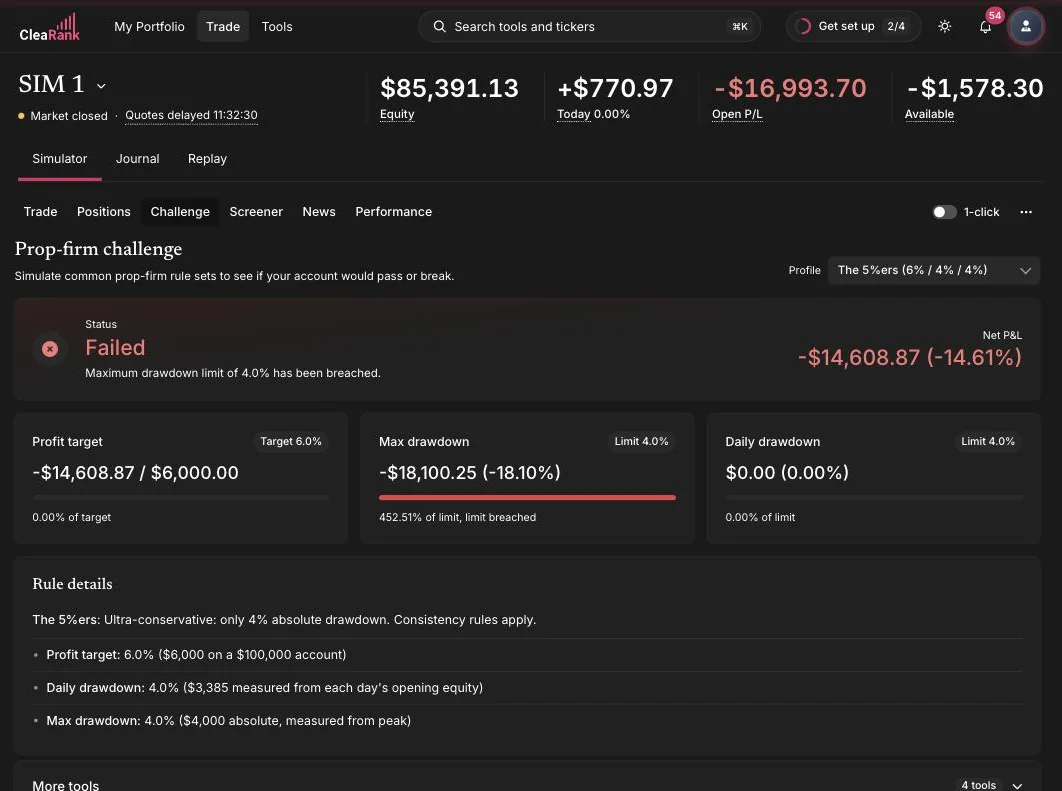
How the tab tracks you
Pick a Profile from the dropdown at the top right of the tab, then trade the account normally. Challenge Mode re-checks the profile’s rules against your live simulator account as trades close, so the verdict and the progress bars are always current and there is nothing to run by hand.
Three numbers drive every profile: a profit target, a daily drawdown limit, and a maximum drawdown limit, each set as a percentage of the account’s starting equity. Each one gets its own card with a progress bar and the exact dollar figures, and the Status card above them carries the current verdict and names the rule that broke if one did.
The seven profiles
The profile you pick changes how much room you have far more than the name attached to it. Read each one as profit target / daily drawdown / maximum drawdown, all as a percentage of starting equity.
- FTMO Phase 1: 10% profit target, 5% daily drawdown, 10% maximum drawdown.
- FTMO Phase 2: 5% / 5% / 10%.
- FundedNext Evaluation: 7% / 5% / 10%.
- MyForexFunds Rapid: 8% / 5% / 12%.
- ThinkCapital: 10% / 4% / 8%.
- The 5%ers: 6% / 4% / 4%.
- Custom: starts at 10% / 5% / 10%, and every field is editable.
Compare the target to the maximum drawdown to see how demanding a profile really is. FTMO Phase 2 asks for 5% while allowing 10% of loss, so you are given twice as much room as you have to earn. The 5%ers asks for 6% while allowing 4%, so you have to earn one and a half times the room you are given, which is the tightest set of numbers on the list. If you are breaching on one of the more forgiving profiles, the thing to change is your risk per trade, not the profile.
Use Custom for two jobs: mirroring the exact numbers of an evaluation you are considering, or holding yourself to stricter limits than any firm would.
Reading the two progress bars
The profit card and the drawdown cards both show a percentage with a bar, and they read in opposite directions. Mixing them up is the easiest mistake on this tab, and it is the one that costs runs.
Percent of target, on the profit card
This is how much of the required profit you have already earned. Higher is better, and 100% means the target is reached. On a $100,000 starting equity with a 6% target, $6,000 of profit reads 100% and $6,576 reads 109.6%.
Anything under 100% while you still have time to trade is normal, and the tab reads In Progress. When the number stalls, the answer is a better payoff ratio or a higher-quality setup, not a bigger position, because raising size is what puts the drawdown bars in danger. The Breakeven Win Rate and Trade Expectancy calculators tell you whether your current plan can reach the target at all.
Percent of limit, on the drawdown cards
This is how much of the loss you are allowed has already been spent. Higher is worse. Under 50% means at least half your allowance is still intact, which is comfortable room. At 80% the tab flips to Warning. At 100% the limit is breached and the run is Failed.
The correct response to a bar between 80% and 100% is to cut position size or stop trading for the day. Trading bigger to win the loss back is what turns a Warning into a Failed, and it is the most common way real evaluations end.
The two drawdown cards are also measured on different clocks. The daily figure is measured against the current trading day and starts over at zero each new day. The maximum figure is measured from the account’s peak equity down to where you stand now, and it never resets: every new equity high moves the peak up, so your remaining room is always measured from the best the account has ever been.
The five verdicts
The Status card only ever shows one of five states, and three of them still leave you a live run.
- In Progress: the run is live, no limit is close, and the profit target is not yet reached.
- Passing: the profit target has been reached with no limit breached.
- Warning: you are within 80% of the daily limit or the maximum limit. Nothing has failed yet, which is exactly why this is the state worth acting on.
- Failed: a drawdown limit has been consumed in full and the run is over.
- Failed (Daily): the same outcome, with the daily limit named, so you can see which of the two broke.
Because this is practice, a failure costs you nothing but the lesson. Write down which rule broke and on which day before you reset, otherwise you will repeat it.
How this differs from the Prop Firm Auditor
Challenge Mode tracks a live practice run as it happens. The Prop Firm Auditor audits trading history you already have, testing it against 180 challenge presets across 31 firms, and it reports its own separate verdicts: Passed, Failed, Incomplete, or No trades supplied.
Use Challenge Mode to build the habit day by day. Use the Auditor when you want to know whether a specific firm’s rule set would have survived the track record you already have.
A practical workflow
- Create a dedicated simulator account. Use New Simulator so challenge practice does not mix into your main practice record.
- Pick the profile you actually mean. Choose the preset closest to the evaluation you have in mind, or set your own numbers with Custom.
- Check the drawdown cards before you size a trade. The number that should decide your size is the room left, not the profit earned. If either bar is past 80%, trade smaller or not at all that day.
- Review every breach. When the status flips to Failed, the card names the rule and the number that broke it. That is the habit to fix, and it is far cheaper to fix here.
Frequently asked questions
Does completing a profile here mean anything to a prop firm?
No. Challenge Mode is education only. It applies evaluation-style rules to your virtual practice balance so you can rehearse the discipline they demand. CleaRank is not affiliated with any prop firm, and nothing that happens on this tab is recognized by one.
Which profiles ship in the Challenge tab?
Seven: FTMO Phase 1 (10% / 5% / 10%), FTMO Phase 2 (5% / 5% / 10%), FundedNext Evaluation (7% / 5% / 10%), MyForexFunds Rapid (8% / 5% / 12%), ThinkCapital (10% / 4% / 8%), The 5%ers (6% / 4% / 4%), and Custom, which starts at 10% / 5% / 10% with every field editable. Each set of numbers is profit target, daily drawdown, and maximum drawdown, as a percentage of starting equity.
My profit bar says 70% and my drawdown bar says 70%. Is that good or bad?
The first is good, the second is not. 70% of target means you have earned 70% of the profit you need. 70% of limit means you have already spent 70% of the loss you are allowed, leaving 30% before the run fails.
What is the difference between daily and maximum drawdown?
Daily drawdown measures the current trading day only and resets at the start of each new day. Maximum drawdown measures the fall from your account’s peak equity to where you are now, and it never resets. Either one can end a run on its own.
Can I restart after a failure?
Yes. Reset the simulator account or start a fresh one and begin again. That is the point of practicing here: fail with no evaluation fee attached, until the limits feel automatic.
Try it yourself
Pick a challenge profile and see if your trading would survive the rules.
Related articles
CleaRank tools are for education and analysis. Nothing in this guide is financial advice.