
How the Broker Risk Analyzer works
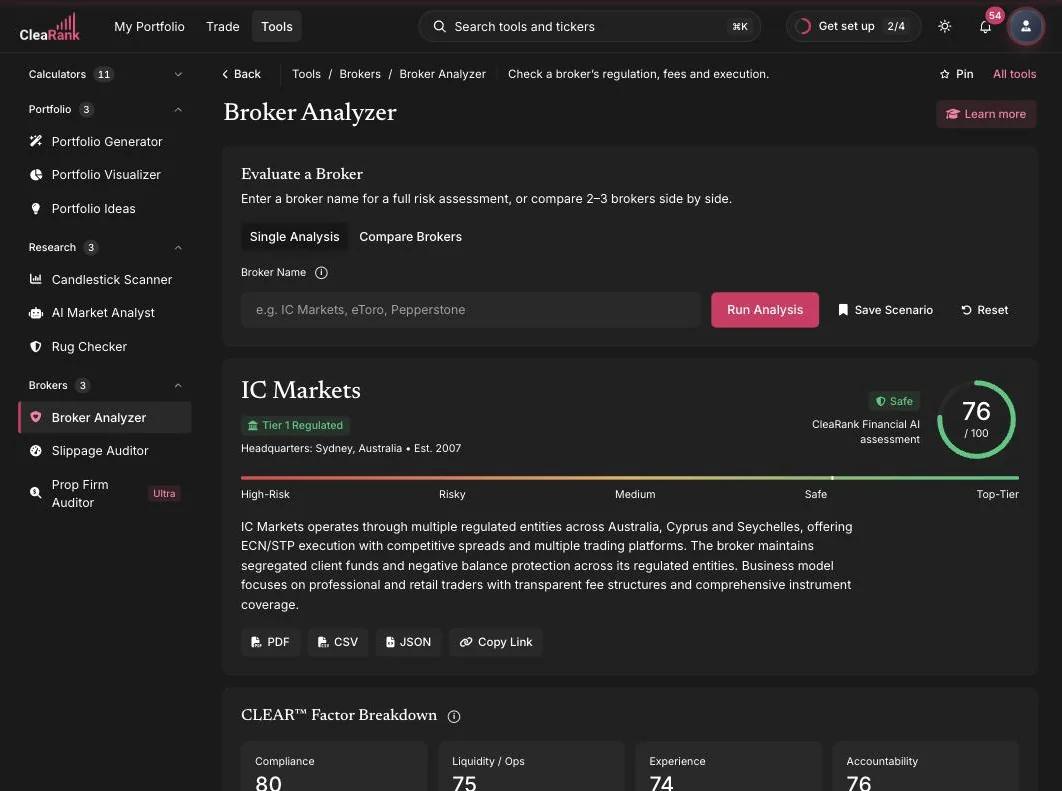
The CleaRank Broker Analyzer runs an AI-assisted risk assessment on any broker you name, using CleaRank’s CLEAR methodology. It returns a 0 to 100 score, five factor readings, tier-colored regulator cards, a radar chart, and a written summary. This guide explains how to run an analysis, how to read each part of the result, and what to verify yourself.
Run an analysis
- Choose the mode. Single Analysis gives one broker a full risk assessment. Compare Brokers puts two or three side by side, which is the more useful mode when you are actually choosing.
- Enter the broker name. Type it as you know it, for example IC Markets, eToro or Pepperstone. The search box offers around 900 broker names as suggestions, but that list does not limit anything: any name you type is analyzed, including small or regional brokers that never appear in a suggestion list.
- Run the analysis. Click Run Analysis and read the report. Save Scenario stores the setup for a later re-run, and Reset clears the form. You can export the report to PDF, CSV or JSON.
The five CLEAR factors
CLEAR is CleaRank’s framework for broker risk. Every broker is assessed on the same five factors, which is what makes two reports comparable. Each factor gets its own 0 to 100 reading and its own tile.
- C is for Compliance. Regulatory posture and licence integrity. This asks who authorizes the broker, whether those licences are current, and whether the entity you would sign with is actually the regulated one. It is the factor that most directly determines whether anyone can help you if the relationship goes wrong.
- L is for Liquidity and Operations. Operations, execution and counterparty depth. This covers where the broker sources its prices, how orders are handled, and how well capitalized the operation behind them appears to be. Weakness here shows up in daily life as requotes, widened spreads at exactly the wrong moment, and withdrawal delays.
- E is for Experience. The real-world user sentiment signal: what clients report about the broker in practice, especially around withdrawals, support responsiveness and account closures. It is the softest of the five and the most easily gamed by paid reviews, so weight it as corroboration rather than evidence.
- A is for Accountability. Transparency of fees, ownership and disclosures. Can you find out who owns the firm, what the full cost of trading is, and what the terms say about dormant accounts, bonus clawbacks and negative balances, without having to dig? Firms that make this hard are usually making it hard deliberately.
- R is for Reliability. Multi-year track record and stability. How long the firm has operated, through what market conditions, and whether it has rebranded, changed entities or moved jurisdictions along the way. A broker with fifteen years under one name and one regulator is a different proposition from one with the same name and a third licence in three years.
The score and what each band means
The headline is a 0 to 100 ring score with a risk label. The bands are:
- 80 to 100, Top-Tier. Strong regulation, a long record and no significant red flags surfaced. Still verify the licence yourself, because a strong score is a prompt to check, not a substitute for checking.
- 61 to 79, Safe. Sound overall with something worth a second look, often transparency or track record rather than regulation. Read the written summary to see which factor pulled it down.
- 41 to 60, Medium Risk. Real concerns. Common causes are offshore-only regulation, a short history, or persistent complaints. Reasonable people avoid this band for anything but small amounts.
- 21 to 40, Risky. Serious concerns across more than one factor. Treat any money sent as money you may not recover.
- 0 to 20, High Risk. Enforcement action, no verifiable regulation, or patterns consistent with a scam. Do not fund an account here.
One thing worth knowing about how the number behaves: regulation can override everything else. Where an enforcement action or negative regulator finding surfaces and there is no active top-tier or second-tier licence, the overall score is capped at 25 and the label is forced to High Risk regardless of how good the other factors look. If a negative finding exists alongside an active top-tier or second-tier licence, the cap is 55. Where no regulation can be found at all, the score is capped at 40. In the other direction, an active top-tier licence with no negative findings puts a floor of 75 under the overall score, and an active second-tier licence with no negatives puts a floor of 60. In other words, licensing sets the range and the other four factors move the score inside it.
The four regulator tiers
Each licence the report finds is shown as a tier-colored card. Regulation is the single strongest structural signal about a broker, and the tiers are about one thing: what actually happens to your money when something goes wrong.
Tier 1, institutional grade
Regulators such as the FCA, ASIC, CFTC and NFA, FINMA, BaFin, MAS, Japan’s FSA, IIROC and CIRO, the SEC, FINRA, AMF France, CONSOB and CNMV. These impose capital requirements, mandate that client funds are segregated from the firm’s own money, supervise conduct actively, and run enforcement with real consequences. Several also operate compensation schemes that pay out if the firm fails. This is the tier where a complaint has somewhere to go and where an insolvency does not automatically mean your balance is gone.
Tier 2, MiFID and equivalent
Regulators such as CySEC, FSCA, DFSA, FMA, MFSA, BCSC, OSC, Hong Kong’s SFC, CMA Kuwait, QFC, FSMA, AFM, Denmark’s FSA, Sweden’s FI, and CSA. These are genuine regulatory regimes with client-money rules and complaint procedures, and many sit inside the European framework. Supervision and enforcement are generally lighter than Tier 1, and the practical protections, including any compensation limits, are usually smaller. Perfectly reasonable to trade with, worth reading the specifics.
Tier 3, offshore and light-touch
Regulators such as the FSC in Belize, SVG’s FSA, VFSC, the Seychelles FSA, IFSC, Labuan FSA, BVI FSC, CIMA, GFSC, Malta, the Isle of Man FSA, FSC Mauritius, GFIN, VARA and AIFC. Registration in these jurisdictions is cheap and quick, ongoing supervision is minimal, and client-money protections are thin or unenforced. In practice, if the firm stops answering your emails, an offshore registration gives you very little leverage and no compensation scheme. Many otherwise reputable brokers run an offshore entity specifically to offer higher leverage, so the question is not whether the group has an offshore arm but whether your account would be opened with it.
Tier 4, unregulated or blacklisted
Anything that does not match a recognized regulator, plus firms carrying warnings or enforcement history. There is no client-money segregation you can rely on, no complaints process and no recourse. Money sent to a Tier 4 firm should be treated as money you have chosen to risk entirely.
The radar chart and the written summary
The radar chart plots all five CLEAR factors on one shape, so the trade-offs are visible at a glance. A broker can be well regulated and weak on transparency, or have a long track record and thin operations, and a lopsided radar makes that obvious faster than reading five numbers. In Compare Brokers mode, overlapping shapes are the quickest way to see where two firms actually differ.
Alongside it, a CleaRank Financial AI summary explains the findings in plain language: what stands out, where the risks concentrate, and what is worth verifying yourself. Like the scores, this text comes from what CleaRank Financial AI learned in training rather than from live sources, so read it as an organized argument rather than as reporting.
What to verify yourself
Every report is a research aid. These four checks take about ten minutes and are the ones that actually protect you.
- Look the licence up on the regulator’s own register. Search the regulator’s website directly, never a link supplied by the broker. Confirm the company name, the licence number and that the status reads active.
- Match the entity to your account agreement. Check which legal entity your account would be with, and confirm that entity is the one holding the licence you just found.
- Check the regulator’s warning list. Most Tier 1 and Tier 2 regulators publish lists of unauthorized firms and clone firms that impersonate real ones. A clone uses a genuine licence number with a different website.
- Test the money path with a small amount. Deposit a small sum, trade briefly, then withdraw it. A withdrawal that takes an unexplained two weeks tells you more than any score.
A note on repeat runs: a report you have already run comes back instantly for the rest of the day rather than being rebuilt, so analyzing the same broker twice in a day usually returns the report you already saw. If you are not signed in, there is also a limit on how many brokers you can analyze in an hour.
See also the broker check page on the marketing site at clearank.com/tools/broker-check/. Once you have an account open, the Slippage and Fee Auditor is the natural follow-up: this tool assesses structural risk, that one measures what the broker’s execution actually costs you in money.
Frequently asked questions
Does CleaRank keep a database of pre-scored brokers?
No. There is no broker index and no stored scoreboard. You name a broker and CleaRank Financial AI produces the assessment at that moment, structured by the CLEAR framework. The suggestion list in the search box is a convenience for typing, not a limit on what can be analyzed.
Does the tool check regulator registries in real time?
No. The regulator names, licence details and narrative come from what CleaRank Financial AI learned in training, not from a live lookup, and they can be out of date or wrong. Always confirm a licence on the regulator’s own website before funding an account.
What do the five CLEAR factors stand for?
Compliance covers regulation and licence integrity, Liquidity and Operations covers execution and counterparty depth, Experience covers real-world user sentiment, Accountability covers transparency of fees, ownership and disclosures, and Reliability covers the multi-year track record.
Why did a broker with good reviews still score badly?
Usually regulation. A negative regulatory finding without an active top-tier or second-tier licence caps the overall score at 25, and no verifiable regulation at all caps it at 40, regardless of how the other factors look. Sentiment cannot outweigh the absence of recourse.
Is a high score an endorsement?
No. The score summarizes what the CLEAR framework examined, and it is a research aid rather than a recommendation. Verify the regulatory status directly with the regulator before you fund anything.
Try it yourself
Run a CLEAR analysis on any broker worldwide.
Related articles
CleaRank tools are for education and analysis. Nothing in this guide is financial advice.