
Prop Firm Auditor: Audit Your Trading Against Prop-Firm Rules
The CleaRank Prop Firm Auditor runs your existing trading history through a prop firm’s rule set and reports whether you would have passed. It replays every trade against the rules and returns a verdict on each one, covering drawdown, consistency, and the rest of the rule set, with the worst breach quantified. This guide covers choosing a firm, supplying your trades, and running an audit.
Why audit before you pay
Prop-firm evaluations are not a test of whether you can make money. They are a test of whether you can make money inside a specific set of constraints: a profit target, a daily loss limit, a maximum drawdown, sometimes consistency and weekend rules on top. Plenty of profitable traders fail evaluations, not because their strategy is bad, but because its natural drawdown profile collides with the firm’s limits.
An audit answers that question with your own data before any fee changes hands. If your last three months of trading would have breached a firm’s trailing drawdown twice, you know to adjust your risk, or pick a different challenge, before buying the attempt. And if a firm has already failed you, an audit is a way to check the verdict against your own records, with timestamp-level evidence.
How an audit works
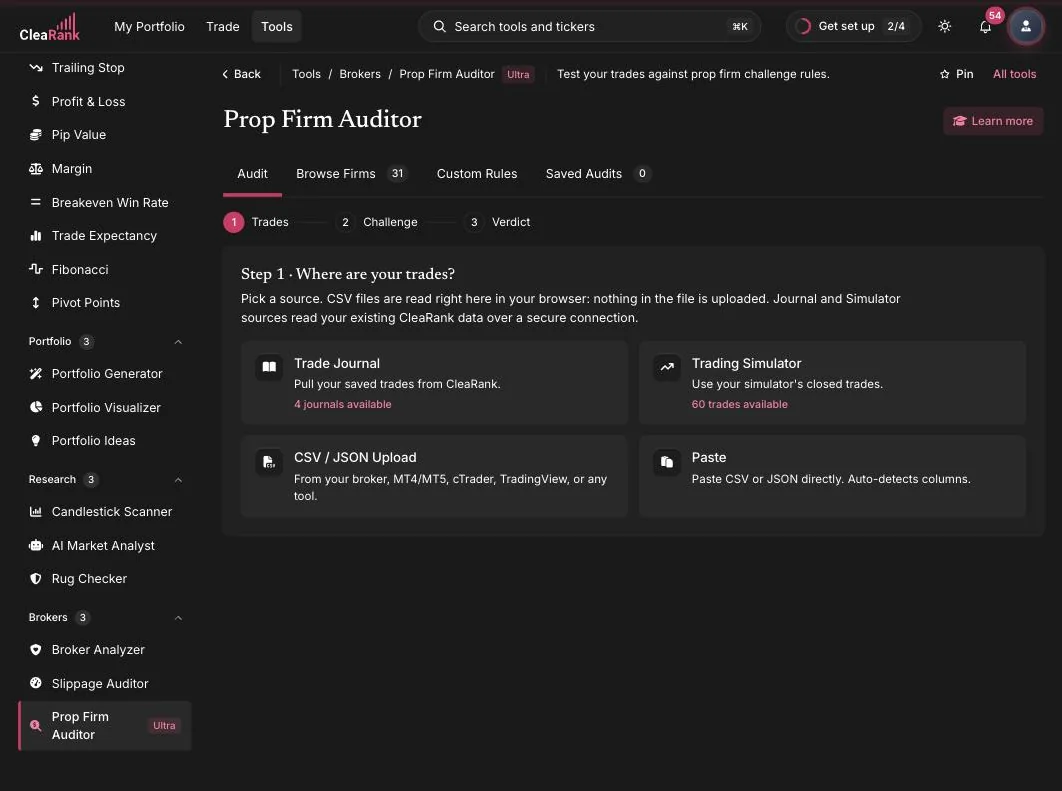
The auditor walks you through three steps: Trades, Challenge, Verdict.
- Pick your trades. Choose the trade history to audit: a journal, a simulator account, an uploaded file, or pasted data.
- Pick the challenge. Search the preset library by firm name and choose the challenge variant and account size from the list, or build a fully custom rule set.
- Read the verdict. Every rule gets its own pass or fail, with the worst breach quantified, plus an overall summary.
Where your trades come from
- Trade Journal: audit any of your journals, including journals built from imported broker history. The journal also offers a direct deep link into the auditor.
- Trading Simulator: audit the closed trades of a simulator account. This pairs naturally with practicing a challenge on a virtual practice balance first.
- CSV or JSON upload: bring a file straight from your broker or platform, including MT4/MT5, cTrader, and TradingView exports.
- Paste: paste CSV or JSON directly and the auditor works out the columns for you.
Privacy note: files you upload and data you paste are read and analyzed inside your browser. That trade data never leaves your device.
The rules the auditor checks
The auditor evaluates the rule families that decide real evaluations. Each rule is checked across your full history, day by day and trade by trade.
Profit target
Did the account reach the required gain? The auditor tracks cumulative P&L against the target so you can see not just whether you got there, but when.
Daily drawdown
Most firms cap how much you may lose in a single day, measured against a defined daily baseline. The auditor computes each day’s worst excursion and compares it to the limit, flagging the specific days that breached.
Maximum drawdown: static and trailing
Static drawdown measures against a fixed floor, such as a percentage below starting balance. Trailing drawdown moves the floor up as your equity grows, and it is the rule that catches most traders off guard. The auditor models the common variants: intraday trailing, end-of-day trailing (where the floor only ratchets at the daily close), and breakeven-lock styles, where the floor stops rising once it reaches your starting balance. These distinctions change verdicts, so the auditor treats them as distinct rules rather than one generic “max drawdown”.
Consistency rules
Some firms require that no single day contributes an outsized share of total profit. The auditor computes your best day’s share and checks it against the consistency cap.
Weekend holding
If the rule set forbids holding positions over the weekend, the auditor scans for trades held across it and flags each occurrence.
Minimum trading days
Evaluations often require activity on a minimum number of days. The auditor counts your qualifying days against the requirement.
Firm presets and custom rules
The Browse Firms library covers 180 challenge presets across 31 firms, and the count shown on the tab always reflects the presets currently in the tool. Search by firm name, then pick the challenge variant and account size you want from the list. Presets are modeled on published evaluation rules, and since firms revise their terms, always confirm the current rules with the firm before paying for an attempt.
If your target is not listed, or you want to stress-test a hypothetical, Custom Rules lets you compose a rule set from scratch: target, daily loss, drawdown style and size, consistency, weekend, and minimum-day rules. You can also save audits and return to them later from Saved Audits.
Reading the verdict
The banner at the top of the result shows one of four states. No trades supplied means there were no trades to read, so nothing was evaluated. Failed means at least one hard-fail rule broke: maximum drawdown, daily drawdown, maximum trading days, consistency, or weekend holding. Incomplete means nothing hard-failed, but the profit target has not been reached yet or the minimum trading days have not been met yet, so the challenge simply is not finished. Passed means every rule that applied passed. A hard fail always wins: an account that breached drawdown and also missed the target reads Failed, not Incomplete.
The verdict is per rule, not just an overall grade. Each rule card shows pass or fail, and quantifies the worst breach, for example the single worst daily loss against the daily limit, or how far equity dipped below a trailing floor. That number is the actionable part: failing a $5,000 daily limit by $80 is a sizing tweak, while failing it by $2,000 means the strategy and the challenge are mismatched.
Use the verdicts iteratively. Adjust your risk per trade, rerun the audit, and watch which rules flip from fail to pass. When your recent history passes cleanly, you have real evidence, not hope, that the evaluation is worth paying for. You can also rehearse a challenge live: the simulator’s Challenge mode tracks prop-firm style rules in real time while you trade on a virtual practice balance.
The Prop Firm Auditor is an independent, educational tool. CleaRank is not affiliated with, endorsed by, or partnered with any prop firm. Presets reflect published rules that firms can change at any time; a passing audit is an analysis of past trading, not a guarantee of future evaluation results.
Frequently asked questions
Can the auditor tell me if I would pass an FTMO-style challenge?
It can tell you whether your past trading would have passed that challenge’s rules, checked rule by rule with the worst breach quantified. That is strong evidence about fit, but it is an analysis of history, not a prediction or guarantee of a future result.
What do the four verdicts mean?
No trades supplied means nothing was evaluated because no trades were provided. Failed means at least one hard-fail rule broke: maximum drawdown, daily drawdown, maximum trading days, consistency, or weekend holding. Incomplete means nothing hard-failed, but the profit target has not been reached yet or the minimum trading days have not been met yet, so the challenge is simply not finished. Passed means every rule that applied passed. A hard fail outranks an unmet target, so an account that breached drawdown and also missed the target reads Failed.
Does my trading data leave my browser?
Files you upload and data you paste in the audit flow are read and analyzed in your browser, so that trade data never leaves your device. Trades you pick from a journal or a simulator account are already saved in your CleaRank account, and the audit itself still runs in your browser.
What is a trailing drawdown, and what is a breakeven lock?
A trailing drawdown is a loss floor that rises as your equity grows, so early profits raise the bar you must stay above. A breakeven lock is a variant where the floor stops rising once it reaches your starting balance. End-of-day trailing variants only move the floor at the daily close. The auditor models each style separately because they produce different verdicts on the same trades.
Can I audit my real broker history?
Yes. Upload a CSV or JSON export from your broker or platform, paste the data directly, or first import it into a journal and audit that journal.
Is CleaRank affiliated with any prop firm?
No. The auditor is independent and educational. Firm presets are modeled on publicly published rules, and you should verify current terms with the firm before purchasing an evaluation.
Try it yourself
Audit your last three months of trading against a challenge in minutes.
Related articles
CleaRank tools are for education and analysis. Nothing in this guide is financial advice.