
Written by Michelle Sofia Michelle Sofia
Market Analyst
As a financial journalist and a SEO specialist my passion for making education in finance accessible runs deep. My work combines hands-on market trend analysis with straightforward writing to create content that’s both informative and easy to understand for the average reader. At CleaRank, we’ve built our reputation on a simple idea: transparent broker comparisons shouldn’t be reserved for experts because everyone deserves clear and transparent information, especially when it comes to choosing a broker. Day to day, I focus on refining our educational materials to maximize their visibility and usefulness across trading communities. using our CLEAR™ Methodology The CLEAR™ Score (Credibility, Leverage, Execution, Accessibility, Regulation) is our proprietary ranking system. The CLEAR™ Score provides you with the most accurate and transparent broker ranking after evaluating all the key factors that are crucial for trading success. .
Last fact checked on July 1, 2025
Types of Markets and Instruments
After getting the basics of the stock market down, it’s time to learn the various types of markets and instruments available for trading. Don’t worry—breaking them down makes them much easier to understand. By the end of this guide, you should have the clarity you need to cruise across different market opportunities with confidence.
Financial instruments are monetary contracts between parties. If you don’t understand what that means, it’s basically just “money tools” that let you do unique things with your cash. If we were to compare this to a video game, the types of markets are your different game choices and the instruments are the tools you use to grow your loot (money).
Primary vs. Secondary Markets
The first thing you need to understand is the difference between primary and secondary markets. Think of them as two stages in the life of any financial security that is traded.
Primary Market
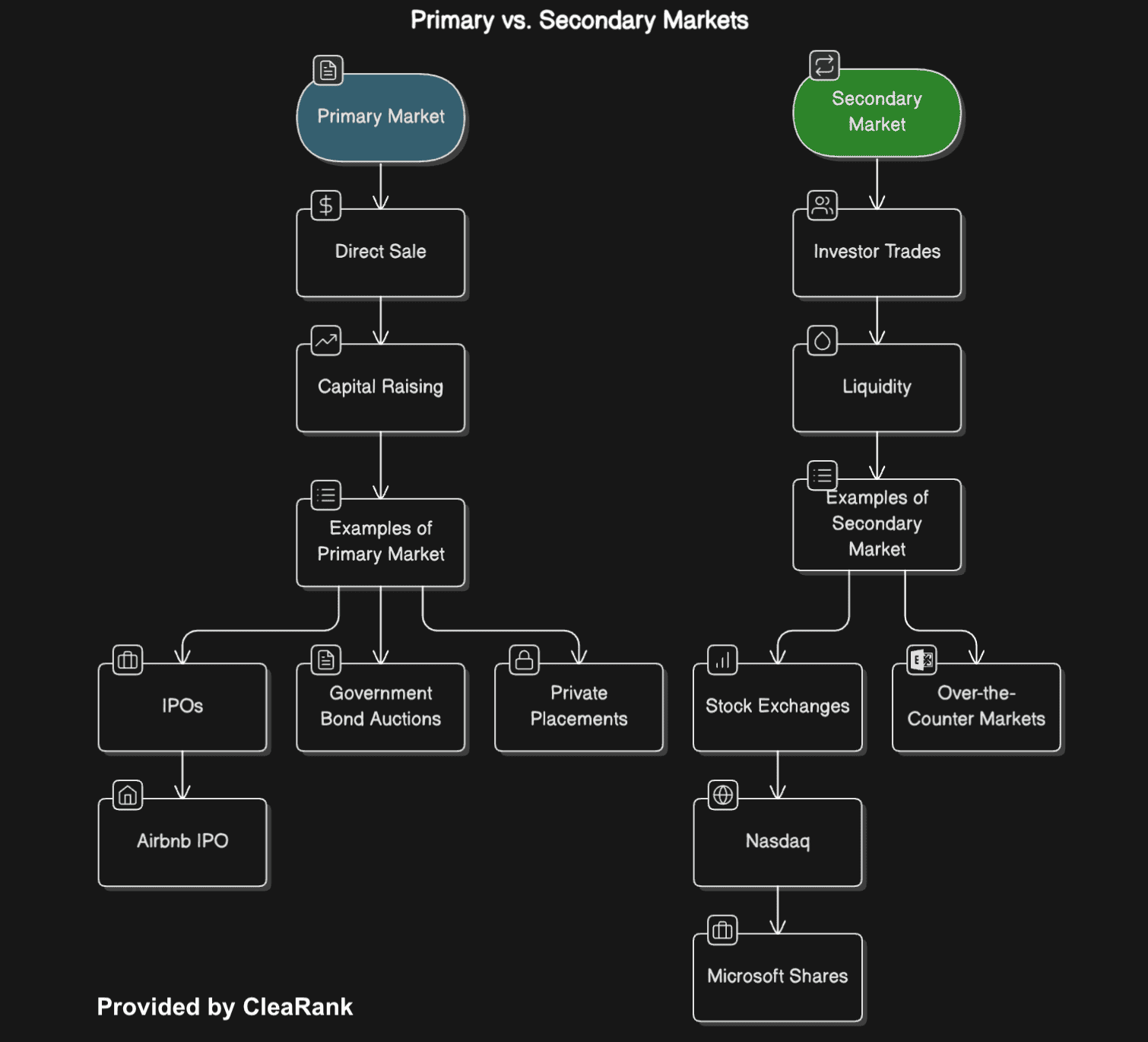
This is the first stage, where everything begins. Companies or governments issue new securities for the first time and sell them directly to investors. This allows businesses to quickly raise some capital in order to fund growth, and it’s also the most effective way for investors to get directly involved from the very start.
Earlier I gave the analogy of market types being the different game choices you have, the primary market can be seen as you buying the video game (security) directly from the developers (company/government), and not from a game store (stock exchange) that sells based on the fluctuations of demand. By doing so, the developers immediately receive your funds and in return you get early access to their video game.
Key Points | What It Means |
|---|---|
Direct Sale | Investors buy directly from the company or issuer, like during an Initial Public Offering (IPO). |
Capital Raising | Companies and governments use this market to raise funds for projects or operations. |
Examples | IPOs, government bond auctions, and private placements. |
For example when a company like Airbnb went public, its shares were first made available to the public in the primary market through its IPO (Initial Public Offerings–buying directly from the company) .
Secondary Market
The secondary market is where you have the opportunity to trade the games (securities) you own, but this time you’re dealing with other players (traders) and not directly with the developers (companies/governments) as in the primary markets.
You can think of the secondary market as the stock exchange, where you can buy and sell shares at the current market. Prices fluctuate based on demand and hype, making a profit is just selling for more than you bought.
Key Points | What It Means |
|---|---|
Investor Trades | Securities are traded between investors, without involving the original issuer. |
Liquidity | Investors can quickly buy or sell shares, thanks to the active trading environment. |
Examples | Stock exchanges like Nasdaq, NYSE, and over-the-counter (OTC) markets. |
For example, if you buy shares of Microsoft on the Nasdaq, you’re participating in the secondary market.
Equity, Bonds, and Derivatives
Now it’s time to break down the most common financial instruments available to you: equity, bonds, and derivatives. Each of these instruments offers a unique opportunity for traders and investors.
Equity
Equity/stocks means having ownership in a company. So When you buy shares, you’re actually buying a piece of that company and may share in its profits/growth, or lose if they fail to deliver.
Type | Description |
|---|---|
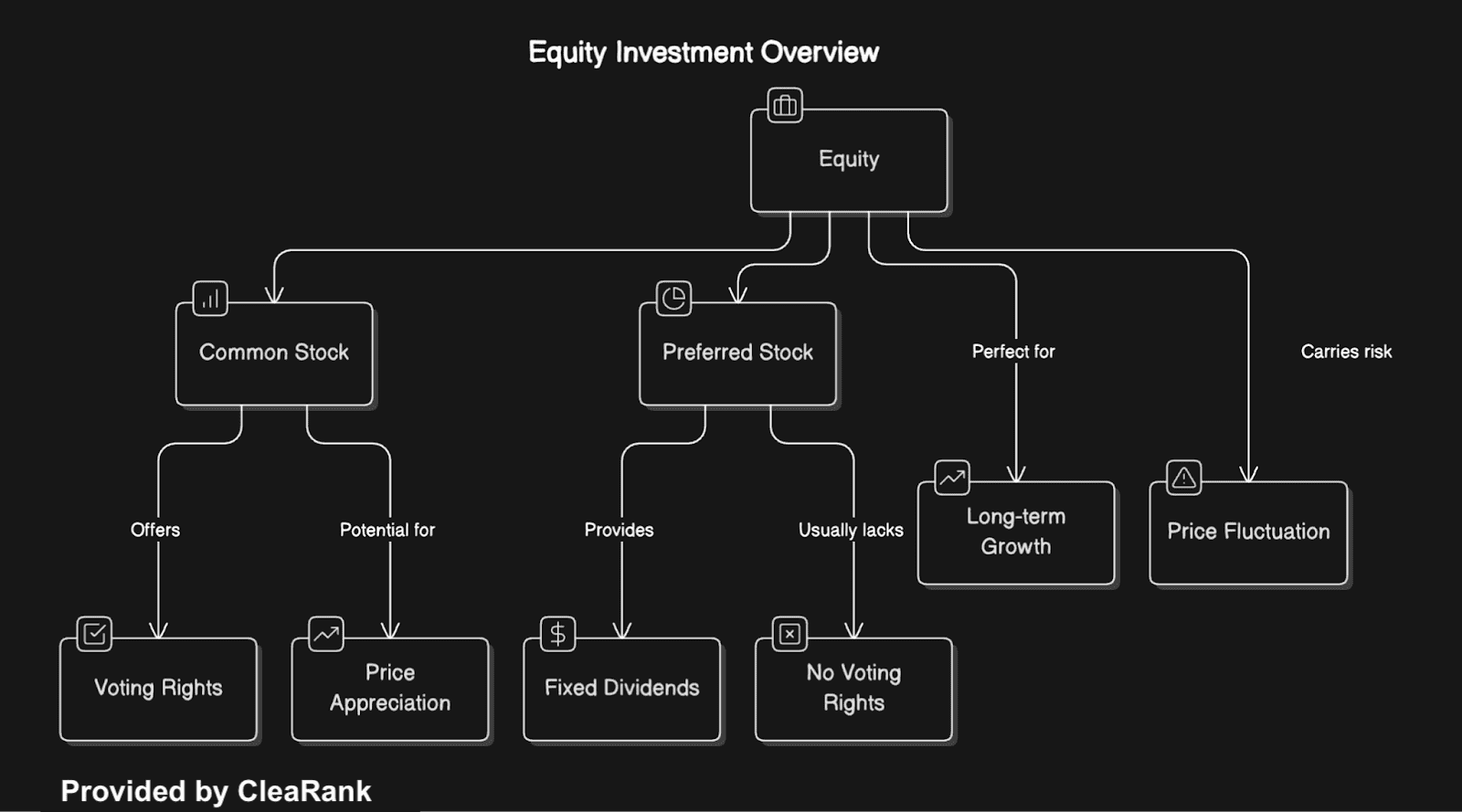
Common Stock | Offers voting rights at shareholder meetings and potential for price appreciation. |
Preferred Stock | Provides fixed dividends but usually lacks voting rights. |
When it comes to equity investments, your goal should be long-term growth.
Some companies also offer dividends. In other words you earn money over time just for owning the stock.
Bonds
Think of bonds as you becoming the bank. Companies and governments come to you for a “loan”, you give them money with the promise of interest over time.
Type | Description |
|---|---|
Government Bonds | Issued by governments and are considered safe investments (e.g., U.S. Treasury bonds). |
Corporate Bonds | Issued by companies, offering higher returns but also higher risk. |
Municipal Bonds | Issued by local governments to fund projects like schools or infrastructure. |
Bonds are ideal for conservative investors seeking steady returns with much lower risks compared to stocks (unless the company goes bankrupt) . Even if a company releases bad news and their stock tanks, they still owe you money for the “loan” you gave them.
Derivatives
Derivatives are financial contracts whose value depends on an underlying asset, like a stock, commodity, or currency. To grasp the concept, think of derivatives as side bets on what might happen to a stock/bond. So you’re not really buying anything, you’re betting on whether it’ll flop or trend.
If you’re reading this guide, you’re most likely not a professional trader or experienced within the financial markets yet. Derivatives are recommended for advanced traders for speculation (short-term bets) or hedging (a risk management strategy–insurance against losses).
Type | Description |
|---|---|
Futures | Contracts to buy or sell an asset at a specific price on a future date. |
Options | Gives the buyer the right (but not the obligation) to buy or sell an asset at a specific price. |
Swaps | Involves exchanging cash flows or financial instruments between two parties. |
Derivatives can be lucrative but they are also complex and come with much higher risks, which is why they are better suited for advanced traders. Unless you’re comfortable taking high risks, treat these like hardcore difficulty mode in gaming—best left to experts until you’ve leveled up your skills.
Mutual Funds and Exchange-Traded Funds (ETFs)
Majority of beginner traders look to minimize risk and diversify their investments.
How? With mutual funds and ETFs–these are pooled investments to give exposure to a mix of assets and effectively spread out risk.
Mutual Funds
A mutual fund collects money from many investors (pooled investments) and invests it in a variety of assets like stocks or bonds. When using a mutual fund, you don’t make any investment decisions, there is a professional fund manager that makes them for you and for the rest of the investors.
Feature | What It Means |
|---|---|
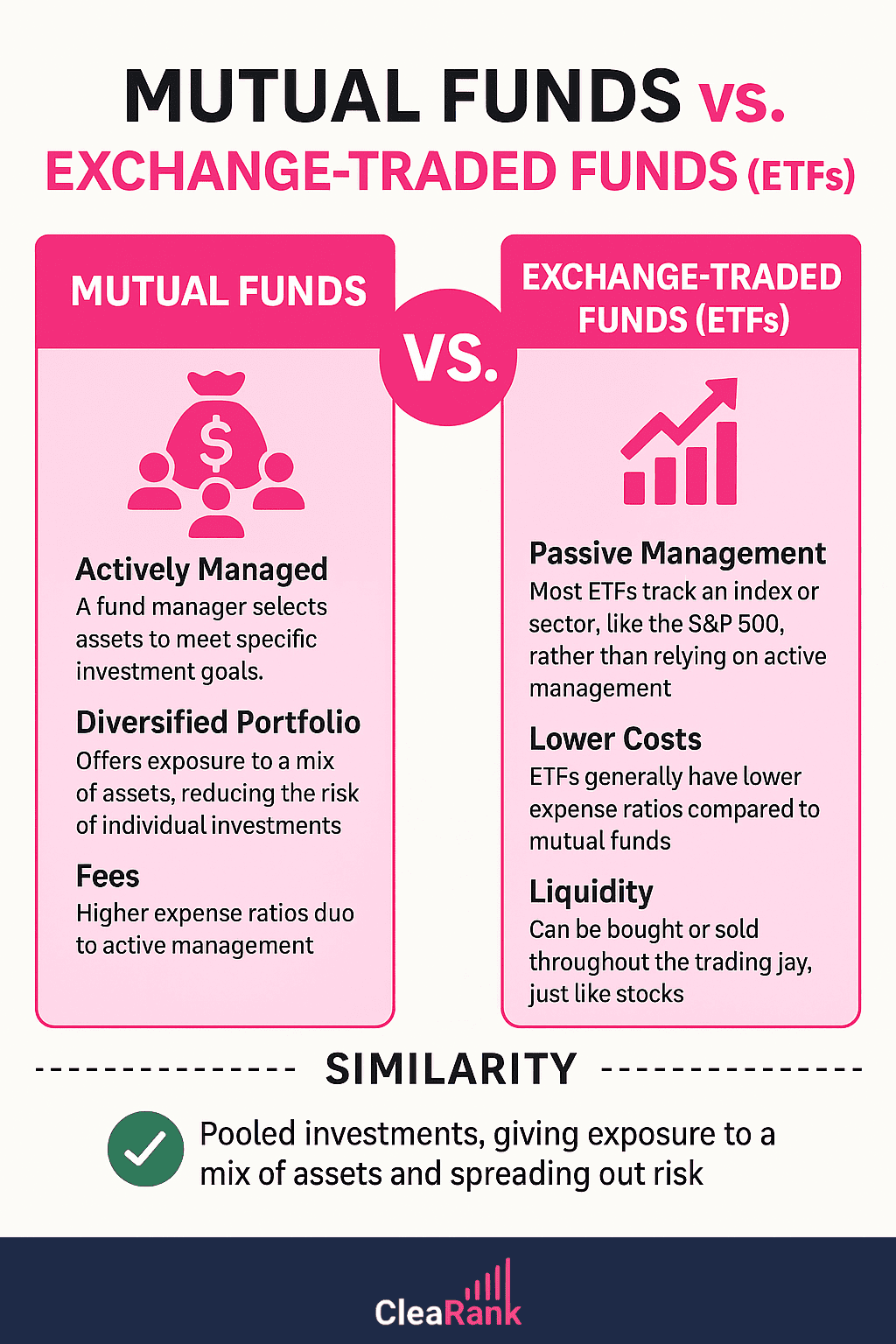
Actively Managed | A fund manager selects assets to meet specific investment goals. |
Diversified Portfolio | Offers exposure to a mix of assets, reducing the risk of individual investments. |
Fees | Higher expense ratios due to active management. |
At this point, you’re probably saying to yourself something like “cool, lower risk for me and someone makes the hard investment decisions in my place!”. Unfortunately everything worthwhile in this world has a price and when it comes to mutual funds, you will have to pay higher fees. Don’t get me wrong, mutual funds are definitely ideal for long-term investors who prefer professional management, but it’s not the cheapest way to invest your money.
Exchange-Traded Funds (ETFs)
ETFs are similar to mutual funds but they trade on stock exchanges like individual stocks. Some would say it’s the best of both worlds. ETFs combine the diversification of mutual funds with the flexibility of stock trading.
Feature | What It Means |
|---|---|
Passive Management | Most ETFs track an index or sector, like the S&P 500, rather than relying on active management. |
Lower Costs | ETFs generally have lower expense ratios compared to mutual funds. |
Liquidity | Can be bought or sold throughout the trading day, just like stocks. |
For instance, if you want exposure to the technology sector, you might invest in an ETF like QQQ, which tracks the Nasdaq-100 Index.
Let’s break this down with a real-world example:
Joe, a 65 year old, is looking to invest some of his capital in technology because he predicts a surge in this sector. Due to Joe’s age and upbringing, he doesn’t really understand (or care about) the specifics of AI, cloud computing, or semiconductors but still sees the potential growth it has. Instead of gambling on individual tech stocks, Joe decides to play it smart and puts his money in an ETF called QQQ. This ETF is a representation of the top 100 stocks in the stock market. By investing in this ETF, our friend Joe successfully invested in companies like Apple, Microsoft, NVIDIA and 97 other top companies in one trade.
If one stock crashes (e.g., Tesla has a bad quarter), Joe’s investment stays stable because the other 99 stocks balance it out. No need to research companies—just trust the overall trend of big tech.
Commodity and Currency Markets
Many investors look to diversify their portfolio even further. Commodities and currencies are two other fascinating markets that offer this opportunity
Commodity Markets
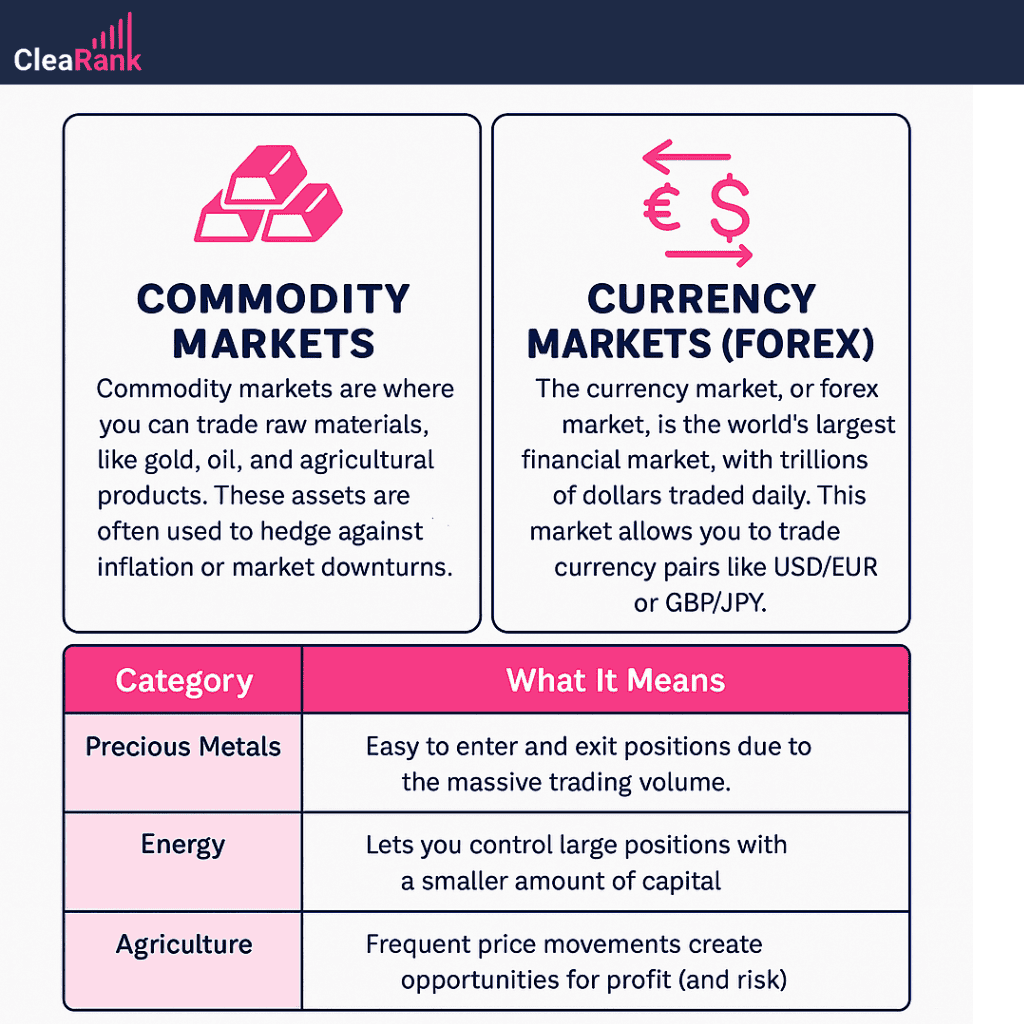
Commodity markets are where you can trade raw materials, like gold, oil, and agricultural products. These assets are often used to hedge against inflation or market downturns.
For Example: if one block of gold is worth 100$, and you buy 10. You now have 1000$ worth of gold. After inflation, the value of the $ goes down but the value of your gold will go up.
Category | Examples |
|---|---|
Precious Metals | Gold, silver, platinum. |
Energy | Crude oil, natural gas. |
Agriculture | Wheat, coffee, soybeans. |
Commodity trading can be done through futures contracts (agreements to buy or sell an asset at a specific price on a future date no matter the price fluctuations due to demand) or through ETFs, making it accessible to both professionals and beginners.
Currency Markets (Forex)
Many have heard of the word forex, but don’t really understand anything about it.
The currency market, or forex market, is the world’s largest financial market, with trillions of dollars traded daily. This market allows you to trade currency pairs like USD/EUR or GBP/JPY.
The currency markets have three main features:
Feature | What It Means |
|---|---|
High Liquidity | Easy to enter and exit positions due to the massive trading volume. |
Leverage | Lets you control large positions with a smaller amount of capital. |
Volatility | Frequent price movements create opportunities for profit (and risk). |
Forex trading is popular among short-term traders who want to profit from frequent currency fluctuations. It’s like riding a rollercoaster of exchange rates. Sounds cool right? But remember: the faster the market moves, the higher the risk. It takes only one sharp swing to turn quick gains into quick losses.
What’s Next: How to Start Trading
After educating ourselves regarding the different types of markets and instruments, our next step is to learn How to Start Stock Trading. You still have no idea on how toset up a brokerage account, select stocks, and craft your first trading strategy. This is where theory meets action, so get ready to take your first steps as a trader.
FAQ
What are the advantages of participating in multiple financial markets?
You drastically reduce the risk of losses when diversifying your portfolio and this allows you to achieve more stable returns over time. Never put all your eggs in one basket, if it drops they all crack.
How can beginners decide which financial instrument to trade?
Beginners should consider their financial goals, risk tolerance, and level of understanding. If you’re a beginner, you definitely shouldn’t start trading before you learn about the different financial instruments available.
Why are primary and secondary markets important for the economy?
Primary markets help businesses and governments raise capital to fund growth and allows investors to get involved from the beginning. Secondary markets provide liquidity and a platform for price discovery that enables efficient trading of securities.
Learn more about the difference between primary and secondary Markets.
What’s the difference between mutual funds and ETFs for investors?
With a mutual fund, you don’t make any investment decisions, there is a professional fund manager that makes them for you, typically at the price of higher fees. ETFs are similar to mutual funds but they trade on stock exchanges like individual stocks.
Learn more about their difference.
Are derivatives only for advanced traders?
Derivatives are recommended for advanced traders for speculation or hedging. They are complex and carry high risk, making them better suited for experienced traders who understand how to manage potential losses.
How do commodity markets differ from equity markets?
Many investors look to diversify their portfolio even further, commodity markets offer this opportunity. They allow traders to deal with raw materials like gold, oil, and agricultural products, contrary to equity markets that focus on buying and selling shares of publicly listed companies.
What makes forex trading unique compared to other markets?
Forex trading involves trading currency pairs and offers high liquidity, leverage, and volatility, making it attractive to short-term traders aiming to profit from frequent currency fluctuations.
Why are bonds considered safer investments than stocks?
Bonds are generally less volatile than stocks and provide fixed interest payments. If you’re an investors seeking steady returns, bonds have much lower risks compared to stocks.
How does leverage work in the forex market?
Leverage comes with much higher risk, depending on the leverage ratio you choose. This allows traders to control larger positions with a smaller amount of capital, amplifying both potential profits and potential losses.
What role do fund managers play in mutual funds?
Fund managers handle the research, buying, and selling of investments—creating tailor-made strategies to hit specific targets (growth, income, etc.). By constantly adjusting the portfolio based on market changes, they save hands-off investors time and effort. Think of them as your full-time investment experts, so you don’t have to track the markets yourself.
Michelle Sofia
CleaRank started with the simple yet powerful vision that transparent and unbiased broker information should be available to everyone, not just those within the industry. This is where I come in with my many years of experience in financial journalism and SEO. Every day, I focus on creating and refining educational content that truly speaks to trading communities and making it both easy to find and genuinely helpful. It’s all about giving people the knowledge they desperately need in order to make informed decisions—step by step, one article at time.