
Written by Michelle Sofia Michelle Sofia
Market Analyst
As a financial journalist and a SEO specialist my passion for making education in finance accessible runs deep. My work combines hands-on market trend analysis with straightforward writing to create content that’s both informative and easy to understand for the average reader. At CleaRank, we’ve built our reputation on a simple idea: transparent broker comparisons shouldn’t be reserved for experts because everyone deserves clear and transparent information, especially when it comes to choosing a broker. Day to day, I focus on refining our educational materials to maximize their visibility and usefulness across trading communities. using our CLEAR™ Methodology The CLEAR™ Score (Credibility, Leverage, Execution, Accessibility, Regulation) is our proprietary ranking system. The CLEAR™ Score provides you with the most accurate and transparent broker ranking after evaluating all the key factors that are crucial for trading success. .
Last fact checked on July 1, 2025
How to Start Stock Trading
You’ve already acquired the basics of the stock market and learned about the different market types and instruments available for trading. It’s time for you to dip your toes in the world of stock trading. Knowing how to start the right way is crucial. In this section, we’ll take you through the essential building blocks you need to begin your journey smoothly.
Choosing a Brokerage Account
Brokerages act as your gateway into the stock market, with them you can buy and sell shares. Brokers impact your costs, access to trading tools and overall experience so choosing the right brokerage is critical.
Key Factors to Consider
Factor | What It Means |
|---|---|
Fees and Commissions | Choose brokers with lowest or zero trading fees as this will impact your bottom line. |
Ease of Use | As a beginner choose a platform that’s intuitive and with a sleek interface |
Research Tools | The more tools the better, search for brokers that offer at least market analysis, stock screeners, and educational resources. |
Customer Support | The markets move fast, so select a broker that offers 24/7 white glove assistance. |
Examples of Popular Brokerages:
- For U.S. investors visit tastyfx.
- For international traders visit Fusion Markets or IC Markets.
When choosing a brokerage, you should first protect yourself by verifying regulation and that the you’re broker is licensed to operate in your region. Otherwise you risk losing all your funds to a shady broker. Afterwards, make sure you’re getting a good deal and check the brokerage’s offering such as their fees and platforms. The broker you pick is your portal to buying stocks, ETFs, or forex. Picking the right one is super important, so prioritize this step and ensure they align with your trading goals.
Some brokers offer demo accounts, you should test them first before fully committing to one.
Understanding Trading Platforms
A brokerage account is only as good as its trading platform. You can look at the trading platform as your command center for executing trades, analyzing stock data, and managing your portfolio. Ideally you would want a brokerage that offers trust-worthy and easy to use platforms.
Features of a Good Trading Platform
Feature | Why It’s Important |
|---|---|
Real-Time Data | Provides up-to-date stock prices and market information. |
Charting Tools | Your toolkit to analyze trends and spot patterns |
Mobile Access | Allows trading on the go, ensuring you never miss an opportunity. |
Custom Alerts | Notifies you of price changes or market events relevant to your portfolio. |
Some Examples of Trading Platforms
- Thinkorswim by Charles Schwab: It’s a top choice for newbie traders as all their features are easily customizable and they also provide advanced features to get your feet wet.
- MetaTrader 5 (MT5): This is the world’s favorite and most renowned platform and the go-to choice for professional traders. You’ll find everything you need here from Algo trading tools to advanced charts.
- Webull: They provide a user-friendly mobile platform that you can test out with zero-commission trading.
You need to consider the trading platform when selecting your first brokerage. If you’re a beginner you should look for one with a more simple and user-friendly interface.
Demat and Trading Accounts
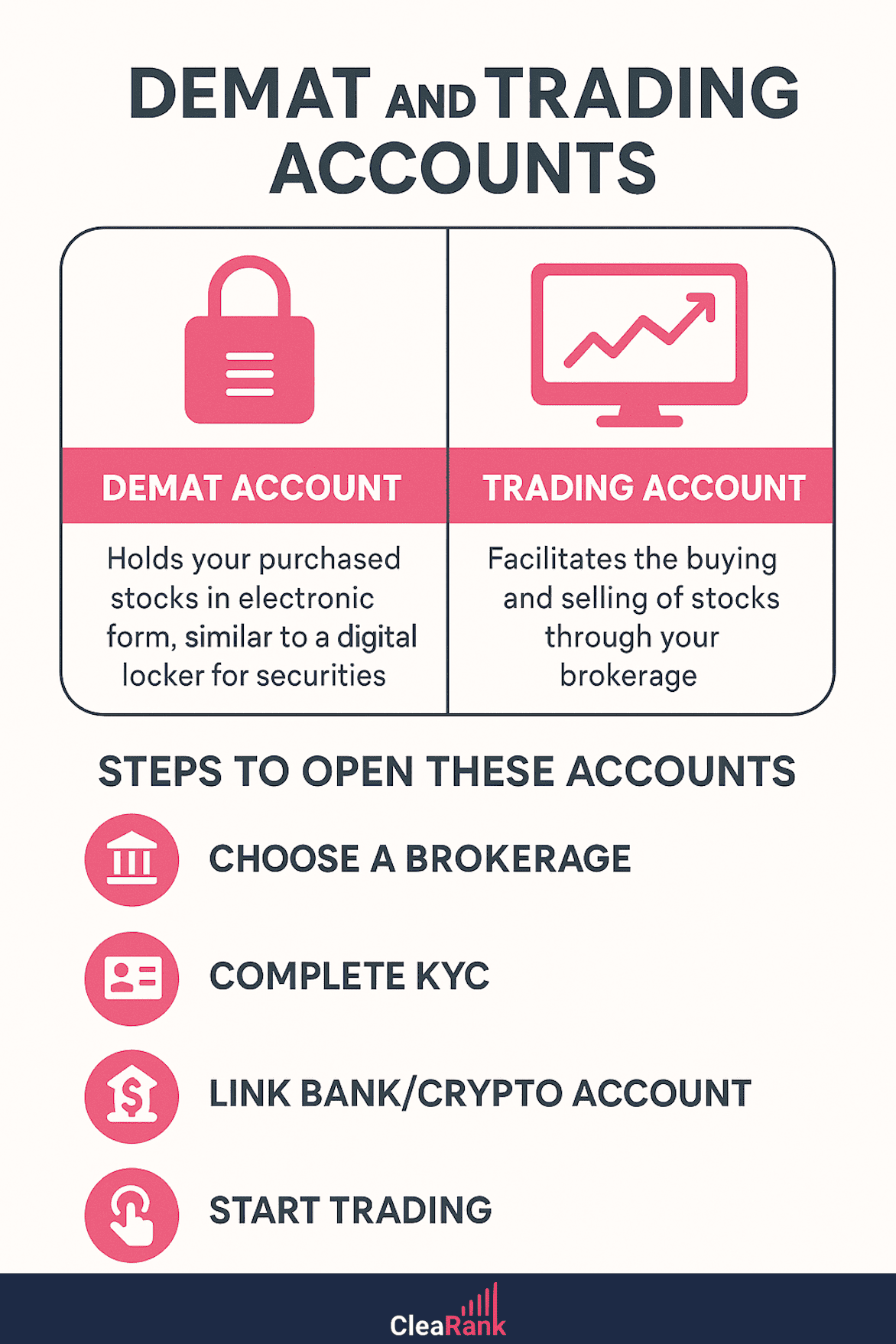
To start trading stocks, you’ll need to get yourself a Demat account and a trading account. Here’s what each one does:
Account Type | Purpose |
|---|---|
Demat Account | Holds your purchased stocks in electronic form, similar to a digital locker for securities. |
Trading Account | Facilitates the buying and selling of stocks through your brokerage. |
To keep it simple, the trading account allows you to execute transactions and the Demat accounts allows you to securely store them in a digital form. Usually both of the accounts are integrated within the broker, meaning you can manage both accounts under one platform.
Steps to Open These Accounts
- Choose a Brokerage: Select a broker that provides integrated Demat and trading account services.
- Complete KYC: Submit proof of identity, address and income for verification. Regulated and trusted brokers require this, if your broker doesn’t request this from you, it might be best to stay away.
- Link Bank/Crypto Account: Ensure smooth transfer of funds for buying and selling stocks.
- Start Trading: Once your accounts are set up and verified, you can start investing!
Order Types: Market, Limit, Stop-Loss
At this stage you should now be capable of investing actual funds and placing orders (buying stocks) safely. Orders are your way of telling your broker how you want to execute your trades, each order type has its purpose and benefits. We recommend learning when to use each one, by doing so you limit your risks and maximize your profits.
Market Order
This is the simplest type of order, it’s executed immediately at the current market price so you get the fastest possible trade.
When to Use It:
- You want to buy or sell quickly.
- Price precision is not a priority (Not ideal when investing large funds).
Example: If Apple shares are trading at $200 and you place a market order, your trade will execute as close to $200 as possible.
Limit Order
Contrary to a market order, a limit order allows you to set the precise price at which you want to buy or sell a stock. This gives you much greater control, however it can take longer to execute if the stock doesn’t reach your specified price.
When to Use It:
- You’re targeting a specific price to maximize profits or minimize costs.
- Market conditions are volatile, and you want precise control over your trade.
Example: You want to buy Tesla shares at $250, but they’re currently $255. Placing a limit order at $250 means the trade will only execute if the stock drops to that price.
Stop-Loss Order
Safest order type and recommended every trade for beginners. This order type secures your investments by automatically selling a stock if its price falls to the specified level your inputted. You can use our stop-loss calculator for precision.
When to Use It:
- You want to minimize potential losses.
- You’re trading in a volatile market.
Example: You own Amazon shares at $180 but set a stop-loss order at $160. If the stock price drops to $160, your shares will be sold to prevent further loss.
Order Type | Description |
|---|---|
Market Order | Executes at the current market price for immediate action. |
Limit Order | Executes only at your specified price or better. |
Stop-Loss Order | Sells automatically when the stock hits your chosen price level, limiting potential losses. |
Pro Tip: You should practice with these different order types with a demo account, this will prepare you for different trading scenarios and strategies moving forward.
Preparing for Your First Trade
Once your brokerage account, trading platform, and order knowledge are in place, it’s time to prepare for your first trade. Start small, the go big or go home approach is not for trading—you’ll likely be going home fast. Start by focusing on a few stocks and gradually increase your exposure as you gain confidence and experience, while learning and growing your skills as you trade.
Tips for Beginners:
- Start with Blue-Chip Stocks: These are established companies with a history of stable performance and so the chances of a meltdown are highly unlikely
- Set Clear Goals: Know whether you’re trading for short-term profits or long-term growth and how much you’re willing to risk. It’s vital to choose the right path for your current trading life cycle.
- Track Your Performance: Keep a trading journal of all your trades, because without it you’ll be in the dark and will never understand what works and what doesn’t.
What’s Next: Fundamental Analysis
Now that you’ve learned how to start your stock trading journey, it’s time to work on your Stock Fundamental Analysis skills. In the next section, we’ll learn together how to evaluate a company’s financial health, industry position and growth potential. This will help you identify which stocks are worth your investment.
FAQ
Do I need a lot of money to start trading stocks?
No, and we recommend you to start little. Many brokers allow you to begin trading with a small initial deposit and some even offer fractional shares that give you the option to invest in expensive stocks with limited capital.
How can I test my stock trading skills before using real money?
You can use demo accounts provided by many brokers to practice trading. This will help you learn the platform and develop strategies without any financial risk on your end.
Why is choosing the right trading platform important?
A good trading platform offers real-time data, an intuitive design and the most essential tools like charting and alerts. You should be on the lookout for the platform that makes trading more efficient and accessible according to your needs.
What are some common mistakes new traders make?
Many beginners often make the critical mistake of trading without a clear strategy. They ignore risk management or invest based on emotions. Protect yourself and your hard-earned money by starting with research and a defined plan.
How do I know which order type to use?
The order type depends on your trading goal. Use market orders for quick execution, limit orders for precise price targets and stop-loss orders to manage risk.
How important is tracking my trading performance?
Tracking your trades helps identify patterns, refine strategies, and improve decision-making over time. A trading journal is a useful tool for this purpose and is highly recommended by CleaRank’s analysts.
Michelle Sofia
CleaRank started with the simple yet powerful vision that transparent and unbiased broker information should be available to everyone, not just those within the industry. This is where I come in with my many years of experience in financial journalism and SEO. Every day, I focus on creating and refining educational content that truly speaks to trading communities and making it both easy to find and genuinely helpful. It’s all about giving people the knowledge they desperately need in order to make informed decisions—step by step, one article at time.