
Written by Michelle Sofia Michelle Sofia
Market Analyst
As a financial journalist and a SEO specialist my passion for making education in finance accessible runs deep. My work combines hands-on market trend analysis with straightforward writing to create content that’s both informative and easy to understand for the average reader. At CleaRank, we’ve built our reputation on a simple idea: transparent broker comparisons shouldn’t be reserved for experts because everyone deserves clear and transparent information, especially when it comes to choosing a broker. Day to day, I focus on refining our educational materials to maximize their visibility and usefulness across trading communities. using our CLEAR™ Methodology The CLEAR™ Score (Credibility, Leverage, Execution, Accessibility, Regulation) is our proprietary ranking system. The CLEAR™ Score provides you with the most accurate and transparent broker ranking after evaluating all the key factors that are crucial for trading success. .
Last fact checked on July 1, 2025
Stock Trading Strategies
Stock trading strategies are your stratagem to outsmarting the markets and achieving your investment desires. Whether you want to make a net profit from short-term cost movements or accumulate wealth over long-term trends, there is a blueprint tailored to your goals, risk tolerance, and trading style.
In this section we will cover a favored trading approach as well as day trading, swing trading, position trading, scalping, momentum, contrarian strategies, and algorithmic trading. Each one of these strategies has its own unique strengths and weaknesses, and with the right interpretation will assist you on how best to cruise the wavy waters the stock market has to offer.
Day Trading vs. Swing Trading
Day trading and swing trading are variants of the most favored strategies for dynamic traders, while both center their attention on short-term price motions, they differ in durations and approaches.
Day Trading
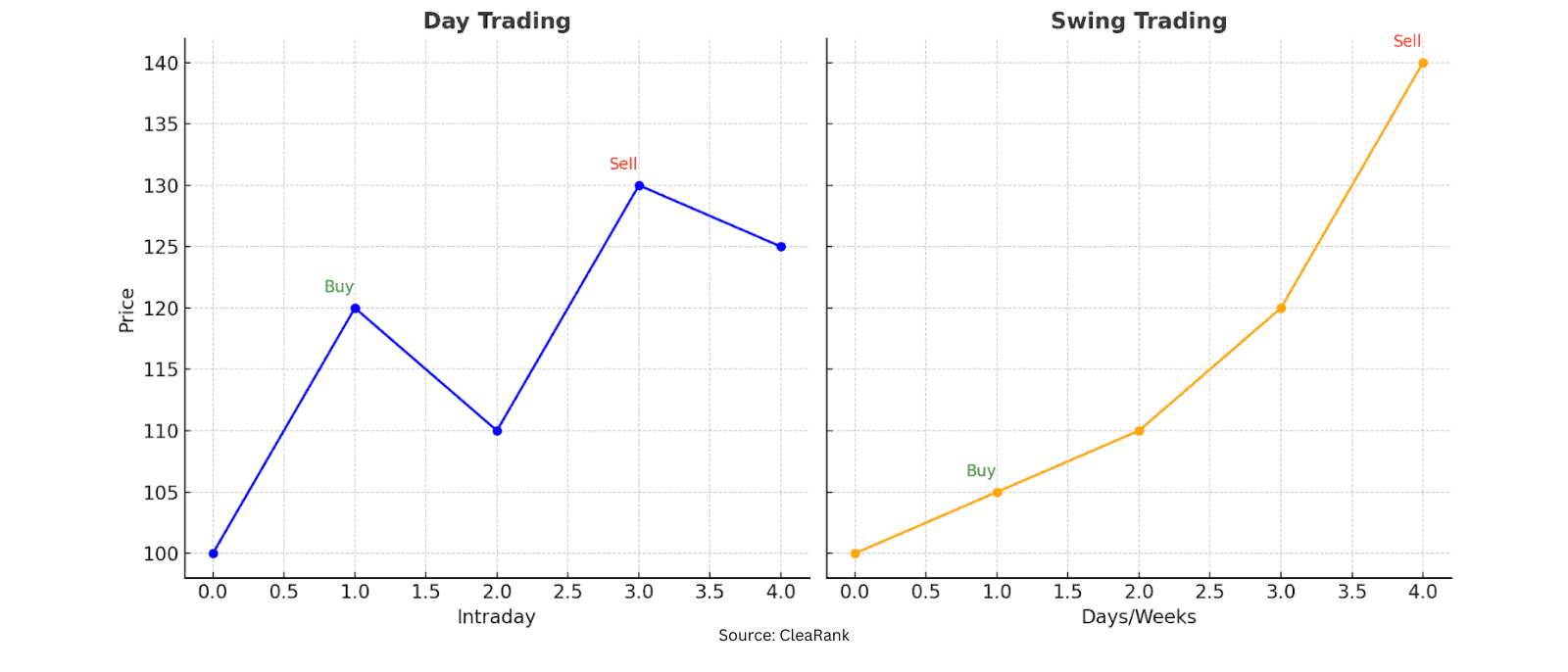
Day trading entails buying and selling stocks within the same trading day to gain from short-term price movements, and selling all positions before the market closes. This keeps you clear from overnight risk and protects your funds.
Note: Day trading is a skill, don’t read this thinking anyone can do it at a whim. If you hope to become a successful day trader, you’ll need to invest your time and energy into honing your skills on a daily basis and staying updated with the latest market news and economic changes.
Characteristic | Description |
|---|---|
Timeframe | Positions are held for minutes to hours but not overnight. |
Focus | High liquidity stocks with significant intraday volatility. |
Tools | Charts, technical indicators, and real-time news for fast decision-making. |
Example: To profit from price differences throughout the day, a trader would buy a stock at $120, expecting it to fluctuate due to market volatility, and close a successful day of trading by selling his shares at $130. Day trader’s must always be on their toes to spot any opportunities during the day.
Swing Trading
Swing trading in layman terms are for those who want to make a quick buck but have no desire to trade all day. Swing trading means holding your position for multiple days or even weeks in an attempt to profit from short to medium term trends and price alterations, hence the term “swing trading”.
Characteristic | Description |
|---|---|
Timeframe | Positions are held for a few days to a few weeks. |
Focus | Stocks showing strong technical patterns or fundamental catalysts. |
Tools | Combines technical analysis with fundamental insights for trend identification. |
Example: A swing trader might go for shares of a company after a positive earnings report was released and will aim to retain them for several weeks to capture the ongoing upward trend.
Day Trading vs. Swing Trading: Main Differences
Aspect | Day Trading | Swing Trading |
|---|---|---|
Holding Period | Intraday only | Several days to weeks |
Risk Exposure | Lower overnight risk | Higher due to holding positions longer |
Trading Volume | High | Moderate |
Time Commitment | Requires full-time focus | More flexible, suitable for part-time traders. |
Position Trading and Scalping
Position trading and scalping are used by many traders, those who would prefer long-term but safer investments and those that would like to thrive from swift trades.
Position Trading
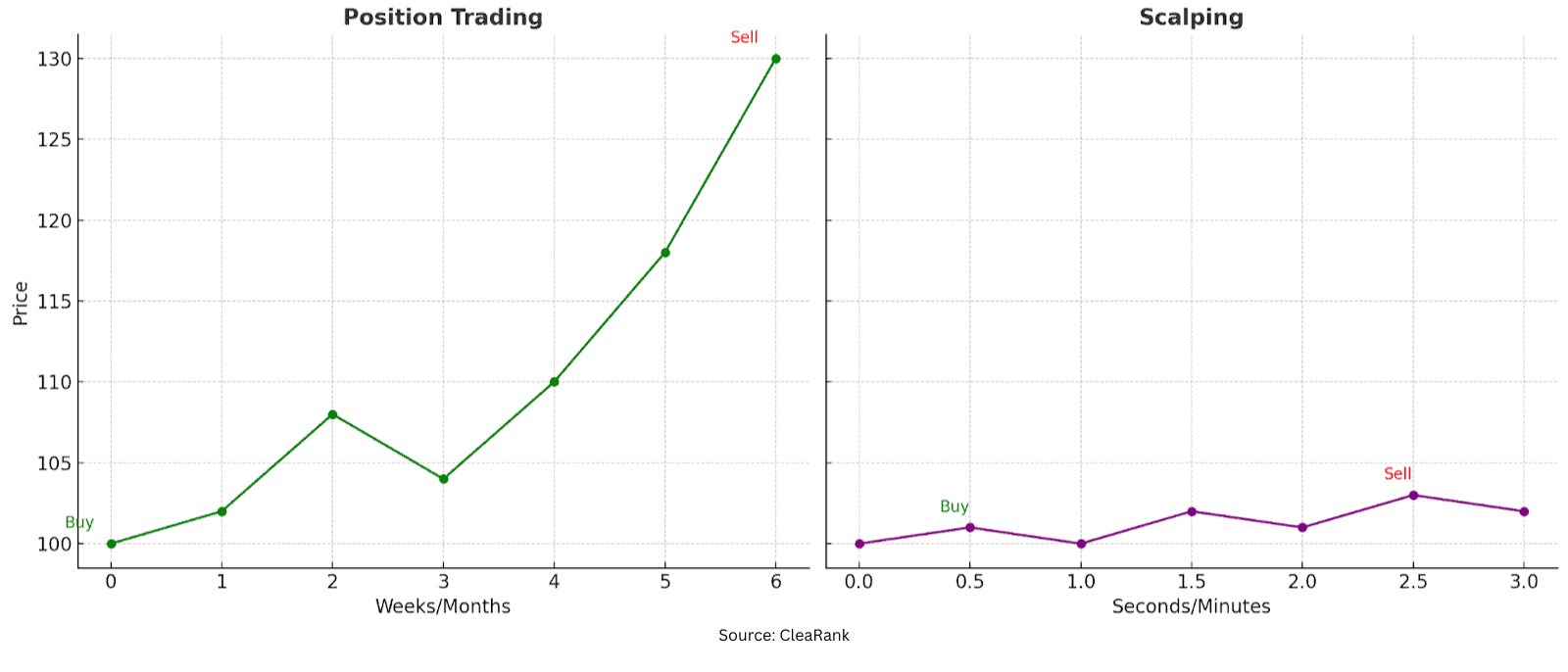
Position trading implies holding a multitude of stock for several months to years, the main focus being on long-term growth. It’s less about the timing of the market and more about pinpointing sturdy stocks that can bring home regular returns
Characteristic | Description |
|---|---|
Timeframe | Months to years. |
Focus | Strong fundamentals, steady growth, and long-term trends. |
Tools | Fundamental analysis, economic data, and macro trends. |
Example: A position trader would hold stocks like Apple, with faith in its beneficial promise to pay off over time based on the company’s innovation and market supremacy.
Scalping
Scalping is a speedy and radical short-term approach that requires implementing dozens of trades in one singular day to gain the chance to earn from miniscule price motions.
Characteristic | Description |
|---|---|
Timeframe | Seconds to minutes. |
Focus | High-volume stocks with tight bid-ask spreads. |
Tools | Advanced trading platforms with fast execution and low transaction costs. |
Example: A scalper would trade the same stock several times a day, gaining small yields from each trade but leaning on quantity to amass large gains.
Position Trading vs. Scalping: Main Differences
Aspect | Position Trading | Scalping |
|---|---|---|
Holding Period | Long-term | Seconds to minutes |
Risk Exposure | Lower short-term risk | Higher short-term risk due to rapid trades. |
Time Commitment | Minimal daily involvement | Intense focus and fast-paced decision-making. |
Momentum and Contrarian Strategies
Momentum and contrarian strategies primarily pivot towards how the market behaves and investor psyche, providing an array of approaches to trading.
Momentum Trading
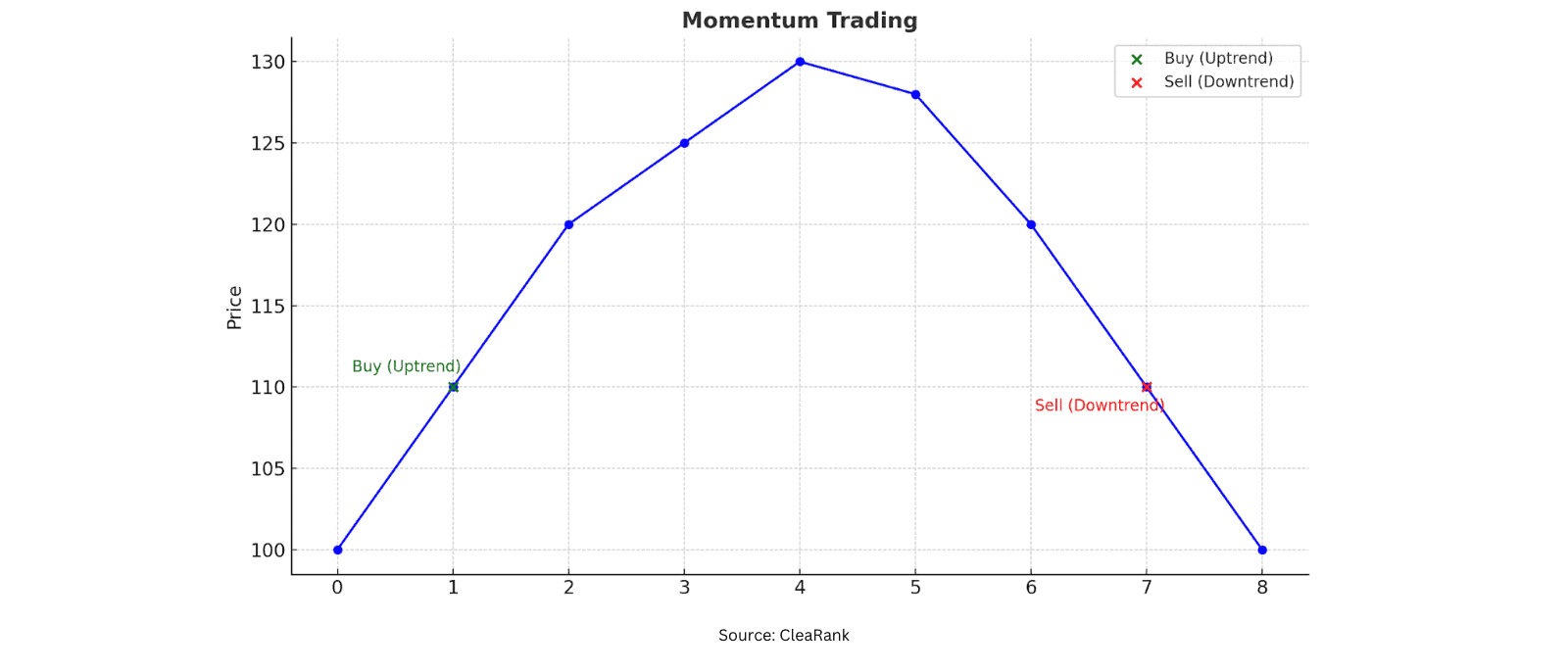
Momentum trading involves buying stocks that are gaining traction and selling stocks that are losing traction. The objective being “cruising the wave” of market sentiment.
Characteristic | Description |
|---|---|
Focus | Stocks with strong price movement and high volume. |
Indicators | RSI, MACD, and moving averages to confirm trends. |
Risk | Overextension can lead to sudden reversals. |
Example: A Momentum trader will purchase a stock that is on an uptrend following the company’s positive earning report or sell if the report is negative.
Contrarian Trading
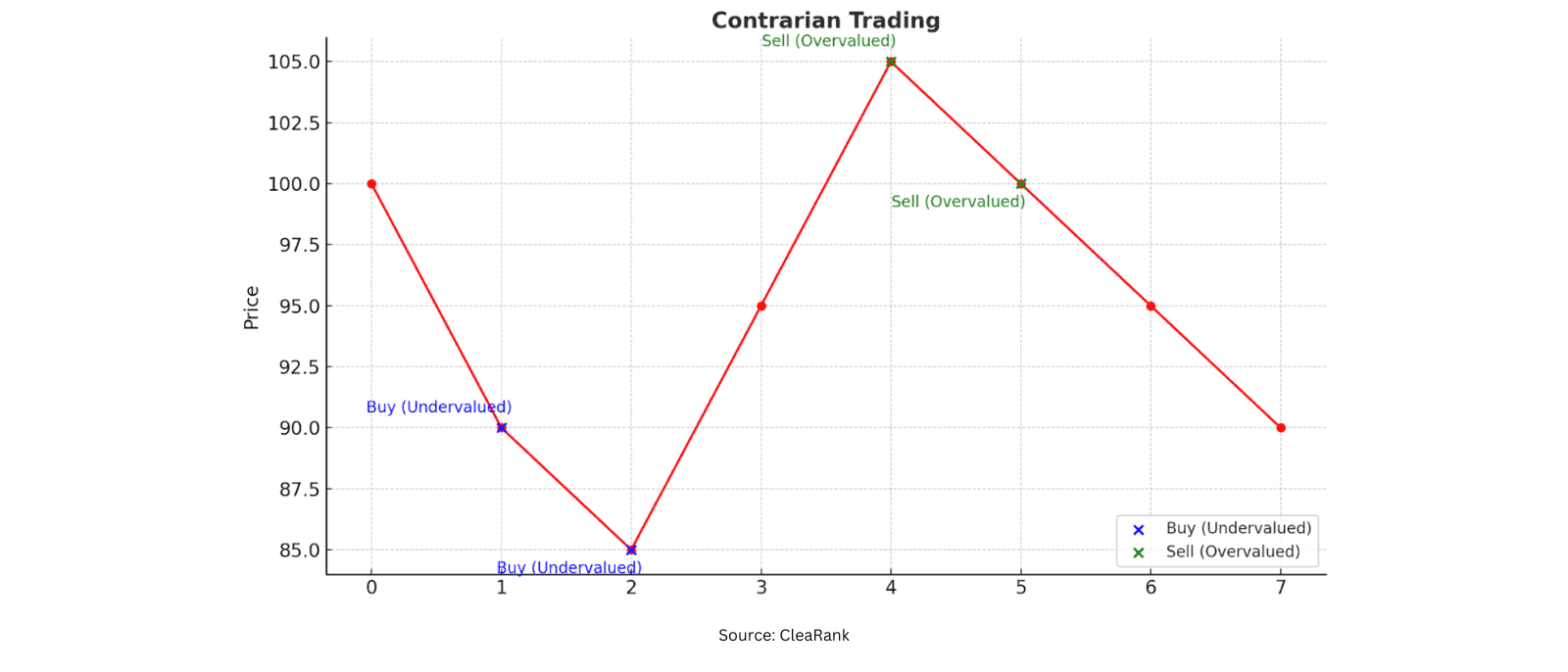
Contrarian trading entails going against market sentiment. Contrarians buy stocks that they think are undervalued due to unfavorable market sentiment and sell glorified stocks driven by hype before they eventually crash.
Characteristic | Description |
|---|---|
Focus | Stocks with significant price deviations from intrinsic value. |
Indicators | Fundamental analysis, P/E ratios, and news sentiment. |
Risk | Market sentiment may remain irrational longer than expected. |
Example: A contrarian may wish to buy shares from a company after market news caused the stock price to dip immensely, having faith it will rebound over time
Momentum vs. Contrarian: Main Differences
Aspect | Momentum Trading | Contrarian Trading |
|---|---|---|
Philosophy | Follows the trend | Goes against the trend |
Risk | Higher risk during reversals | Higher risk if sentiment doesn’t shift. |
Algorithmic and High-Frequency Trading (HFT)
Algorithmic and high-frequency trading (HFT) makes use of technology that executes trades at turbo speeds, often far beyond the skills of your average homosapien traders. These mechanisms have ruled present day markets, accounting for a significant amount of equity, forex, and derivatives trading volumes.
Algorithmic Trading
Algorithmic trading utilizes computer programs to implement trades established on premeditated criteria such as price, volume, or timing.
Characteristic | Description |
|---|---|
Focus | Automates trading to remove emotional decision-making. |
Tools | Advanced software and programming skills. |
Advantages | Executes trades faster and more efficiently than humans. |
Example: An algorithm will create a ‘buy’ order to purchase a stock when it navigates above its 50-day simple moving averages (SMA) and sell it when it tanks.
High-Frequency Trading (HFT)
HFT takes algorithmic trading to a whole nother playing field, employing high tech to achieve several thousand trades every second.
Characteristic | Description |
|---|---|
Focus | Exploits tiny price inefficiencies across markets. |
Tools | Ultra-low-latency connections and powerful algorithms. |
Risks | Can amplify market volatility and face regulatory scrutiny. |
Example: An HFT firm might trade price differences between exchanges, buying thousands, and opting to get rid of them in a fraction of a second.
Algorithmic vs. High-Frequency Trading: Main Differences
Aspect | Algorithmic Trading | High-Frequency Trading |
|---|---|---|
Speed | Fast | Ultra-fast |
Focus | Predefined strategies | Exploiting microsecond inefficiencies. |
How to Begin Applying Trading Strategies
Every beginning is tough and comes with its own set of unique challenges, learning to apply trading strategies is no different. Day traders and scalpers need to be quick on their toes, this requires extensive discipline, while position traders and momentum followers require self-restraint and thorough analysis. Mixing these strategies and adapting them to particular market conditions will improve your overall trading success and give you the confidence you desperately lack as a beginner trader.
What’s Next: Risk and Money Management
Now that you have assorted a wide variety of trading strategies, it’s time for you to divert your attention to our next topic: risk and money management. We’ll go over techniques that will ensure capital safety, set stop-losses effectively, and manage position sizes to hold that sought after long-term success. Understanding risk is just as vital as executing trades, so don’t miss this crucial part of your trading journey!
FAQ: Stock Trading Strategies
Which trading strategy is best for beginners?
Swing trading is the preferred choice for newbie traders due to its relatively laid back pace and the idea of holding your positions for multiple days or even weeks, providing flexibility and learning opportunities. Discover more on how to improve your strategy.
How do I choose the right trading strategy for my goals?
Your decision should align with your financial goals, risk tolerance and time commitment. For example, scalping suits those with rapid decision making abilities, while position trading benefits long-term investors who want a much more relaxed and safer approach.
Is day trading the right way to go for part-time traders?
Day trading usually requires full-time devotion due to its dependence on intraday price movements and decision making. Part-time traders might find swing or position trading more practical.
What are the risks associated with scalping?
Scalping entails high-frequency trading, which inturn increases transaction costs and exposure to short-term market volatility, requiring prices execution and discipline.
Can contrarian strategies work in a strong bull market?
Contrarian strategies may work in any market but are difficult in strong bull markets where sentiment may remain overly optimistic for extended periods.
What is the advantage of momentum trading?
Momentum trading makes the most out of large price movements, giving traders the ability to “ride the trend” and possibly achieve quick gains. However, it does require one to be vigilant to avoid any reversals or wrong calls. Learn more about momentum trading.
How does algorithmic trading reduce emotional decision-making?
Algorithmic trading follows preset rules and behaviour, removing the influence of emotions like fear or greed, which can tend to lead to poor trading decisions.
What’s the difference between swing trading and position trading?
Swing trading targets short to medium term trends, maintaining positions for several days or even weeks, while position trading focuses on long-term growth over multiple months or years.
Why is high-frequency trading (HFT) controversial?
HFT is controversial because it can create market inefficiencies, increase volatility, and provide benefits to firms with high tech, With possibility of putting other smaller investors at a disadvantage.
Can multiple strategies be combined effectively?
Yes, mixing up strategies, such as using momentum trading for entry points and position trading for long-term growth, may provide a more evened out approach and reduce risks in changing market conditions.
Michelle Sofia
CleaRank started with the simple yet powerful vision that transparent and unbiased broker information should be available to everyone, not just those within the industry. This is where I come in with my many years of experience in financial journalism and SEO. Every day, I focus on creating and refining educational content that truly speaks to trading communities and making it both easy to find and genuinely helpful. It’s all about giving people the knowledge they desperately need in order to make informed decisions—step by step, one article at time.