
Written by Jacob Bakshi  Jacob Bakshi
CFD & Options Trading Specialist
Trading CFDs and options has been my playground for years, and I love helping others understand these powerful tools and what makes the financial world tick. My work mostly focuses on giving traders the confidence to make informed decisions with unbiased reviews into platforms that prioritize fair pricing, advanced tools, and reliable execution because In fast-moving markets, every detail matters. I have a background in market analysis and risk management, and I’m always on the lookout for brokers that offer the right tools for serious traders. using our CLEAR™ Methodology The CLEAR™ Score (Credibility, Leverage, Execution, Accessibility, Regulation) is our proprietary ranking system. The CLEAR™ Score provides you with the most accurate and transparent broker ranking after evaluating all the key factors that are crucial for trading success. .
Last fact check on July 1, 2025 by
Shaun David  Shaun David
Regulation • Trading Algorithms • Market Analysis
I’m extremely passionate about the financial markets and working with innovative technology that makes trading better and safer. Since joining the CleaRank team, my primary role is working with real-time broker performance data using the CLEAR™ technology and broker evaluation methodology. I investigate brokers by testing their platforms and uncovering hidden risks and costs. My end goal is to level the playing field for traders and With an extensive background in market analysis and algorithmic trading, I’m qualified to find what matters most to traders.
How Vanguard’s VOO Quietly Dethroned SPY as the World’s Top ETF
If you blinked, you missed it.
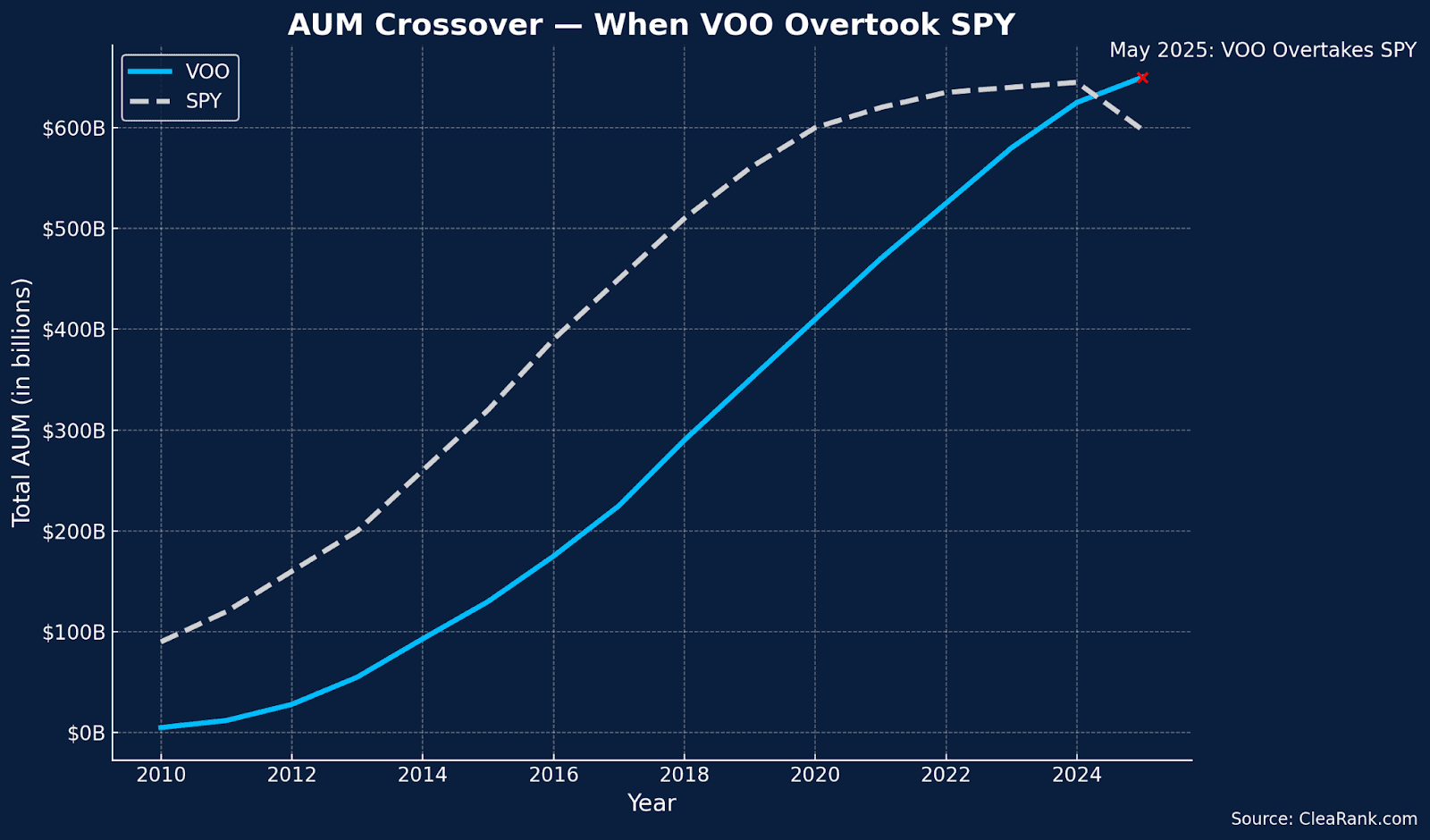
Vanguard’s $VOO, known as the quiet, low-fee tortoise in the S&P 500 race, just overtook $SPY to become the largest ETF in the world by assets under management. That’s right: after more than three decades on top, the legendary SPDR S&P 500 ETF ($SPY) has finally been dethroned. This isn’t just a numbers milestone. It’s a seismic shift in how investors think about fees, behavior, and long-term strategy.
“It’s not just about cost anymore,” says Shaun David, Senior Market Analyst at CleaRank. “It’s about trust, psychology, and how retail money is finally voting with its feet — and its dollar-cost averaging.”
Snapshot VOO’s Quiet Victory
Let’s Talk Numbers
| Metric | $VOO | $SPY |
|---|---|---|
| Inception Date | Sept 2010 | Jan 1993 |
| AUM (May 2025) | $650.2B | $598.7B |
| Expense Ratio | 0.03% | 0.0945% |
| Avg Annual Turnover | 2% | 4% |
| 5-Year Return | 17.52% | 17.43% |
| Dividend Yield | 1.30% | 1.29% |
| Average Daily Volume | 8.6M shares | 77.8M shares |
The Tortoise Strategy: Low Fees Compound Quietly
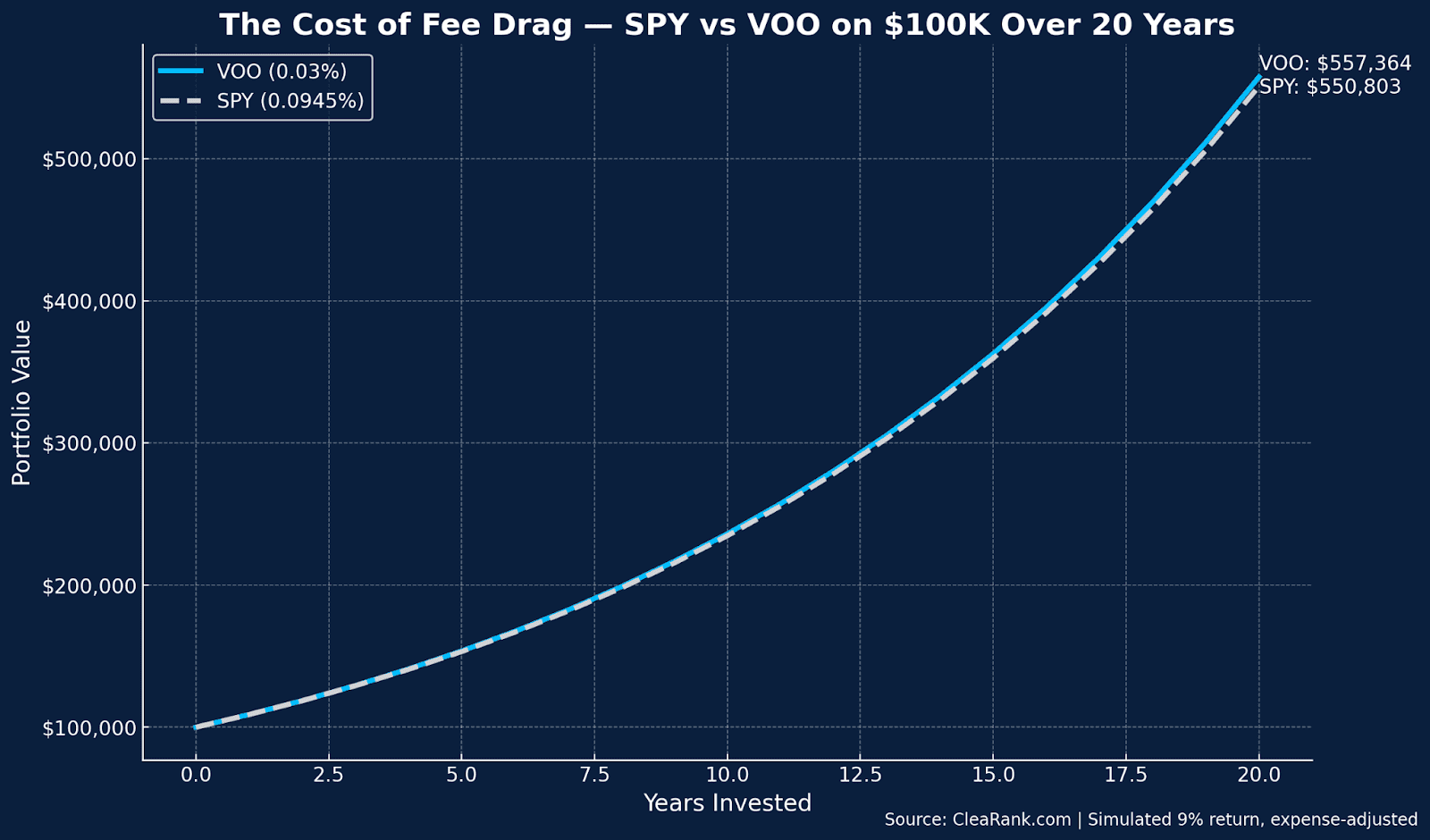
Let’s be honest, saving 6 basis points in expense ratios is not going to garner a lot of attention on Reddit. But over 10 years? That 0.0645% difference between SPY and VOO becomes a real drag.
“Most investors underestimate the burden of fees as they initially seem minor,” Shaun David explains. “It’s not just the 0.06% per year that you need to take into account, it’s 0.06% compounded on gains you didn’t make.”
The numbers never lie, so let’s do the math: if you invest $100,000 and the market returns 9% annually, then the difference between SPY and VOO over 20 years is nearly $19,000 in lost returns, and that’s just from higher fees.
Now imagine you’re Vanguard with 50 million investors.
Fund Flows Tell the Real Story
In 2024, Vanguard’s $VOO pulled in over $116 billion in net new assets. That’s more than any other ETF globally — by a mile.
Meanwhile, $SPY has been bleeding money. Over $22 billion in outflows as traders rotated out, institutions rebalanced, and fee-conscious advisors migrated clients to cheaper options.
“Behavioral flows matter more than performance,” Shaun notes. “The average investor didn’t jump ship because of return gaps. They did it because they finally understood the long-term math of costs.”
VOO became the “set it and forget it” ETF. SPY? Still the trader’s darling — but fading in the eyes of advisors managing grandma’s IRA.
Structure Matters: Why Vanguard Won
SPY is owned and operated by State Street — a for-profit asset manager that collects fee revenue and distributes earnings to shareholders.
Vanguard? It’s mutualized — meaning it’s owned by the very funds it operates. In other words, investors like you and me indirectly own the company. And that means one thing: incentives are aligned.
“Vanguard doesn’t need to please Wall Street,” says Shaun. “They just need to please their investors — and that’s why their fees keep going lower.”
And the result? Stickier money. Fewer redemptions. More long-term trust.
Liquidity Still Belongs to SPY (For Now)
Here’s the one place SPY dominates: daily trading volume. With nearly 10x the average daily volume of VOO, SPY remains the weapon of choice for hedge funds, arbitrage traders, and institutions making billion-dollar moves.
But here’s the twist: those investors don’t care about cost. They care about speed.
“SPY’s liquidity is unmatched,” Shaun says. “But that liquidity doesn’t build loyalty. The moment another fund matches its spread and cost, they’ll switch.”
For retail investors? Liquidity beyond a certain point is meaningless. You’re not placing a $10M order at 9:29 a.m. You’re buying $300 every two weeks. And for that, VOO wins.
Behavior > Alpha
Let’s zoom out.
This moment isn’t just about VOO overtaking SPY. It’s about what investors are waking up to:
This is what Buffett meant when he told his heirs to put 90% of their inheritance into a low-cost S&P 500 fund. Not to maximize gains — but to minimize mistakes.
“The best portfolio isn’t the one with the highest return,” Shaun reminds. “It’s the one you’ll stick with for 30 years.”
Our Verdict: What Should You Do?
If you’re a long-term investor looking to grow wealth passively, VOO is hard to beat. You’ll save more on fees, stay invested longer, and be less tempted to trade.
If you’re an active trader or institutional allocator? SPY still has the edge in liquidity — but it may be time to ask whether that edge is worth the extra cost.
And if you’re just starting out?
“Own the market. Keep it boring. Automate it,” Shaun concludes. “And let compounding work its magic.”
Snapshot of VOO Dominance
FAQ

Jacob Bakshi
I’m Jacob and I specialize in CFDs, options trading, and market analysis. Over the years, I’ve developed a deep understanding of the risks and rewards that come with trading derivatives and survived enough volatility to know that trading is like skydiving: thrilling, but you’d better trust your parachute (or broker). I use CleaRank’s Methodology to test brokers based on their offerings and ensure traders that visit our site have access to brokers that align perfectly with their trading strategies.