
Written by Ryan Brothwell Ryan Brothwell
Financial Journalist
Ryan Brothwell is a seasoned Editor and Journalist with over a decade of experience in the fintech, blockchain, and media industries. Working across Africa and Europe, he has broken stories on everything from new laws to corporate corruption. A self-professed nerd, he enjoys consuming as many books, games and films as he can in his free time. using our CLEAR™ Methodology The CLEAR™ Score (Credibility, Leverage, Execution, Accessibility, Regulation) is our proprietary ranking system. The CLEAR™ Score provides you with the most accurate and transparent broker ranking after evaluating all the key factors that are crucial for trading success. .
Last fact check on May 22, 2025 by
Shaun David Shaun David
Regulation • Trading Algorithms • Market Analysis
I’m extremely passionate about the financial markets and working with innovative technology that makes trading better and safer. Since joining the CleaRank team, my primary role is working with real-time broker performance data using the CLEAR™ technology and broker evaluation methodology. I investigate brokers by testing their platforms and uncovering hidden risks and costs. My end goal is to level the playing field for traders and With an extensive background in market analysis and algorithmic trading, I’m qualified to find what matters most to traders.
CoreWeave Stock Jumps 120% in 2025 as Nvidia Boosts Stake to 7%
Key Points
- CoreWeave shares are up nearly 120% YTD, driven by AI infrastructure demand
- Q1 2025 revenue surged 420% YoY to $982M, with $1.9B in new capex
- Nvidia increased its stake in CoreWeave from 5% to 7% post-IPO
- OpenAI and IBM deals added prestige and a massive revenue backlog
- Risks include heavy losses, high capex, and exposure to tariffs and geopolitics
- CleaRank’s Shaun David sees real infrastructure upside, but warns of AI bubble risk
AI-based cloud computing company CoreWeave saw its share price rocket this past week on the back of better-than-expected results. At 16h00 BST on Tuesday (20 May), the group’s share price was up to $87.88, a 119.69% increase since the start of the year.
This higher share price comes on the back of strong results as well as increasing investment from chipmaker Nvidia. Originally starting life as a cryptocurrency firm, CoreWeave now specializes in providing cloud-based GPU infrastructure to AI developers and companies. It also develops its chip management software.
Its business model essentially sees it renting out its more than 250,000 GPUs to help train Large Learning Models (LLMs) and other AI software. This includes providing services that do not have this technological infrastructure to begin with. It also includes so-called ‘hyperscalers’ like Microsoft and IBM, which have their own GPUs and data centers but might need more capacity to meet growing AI demands.
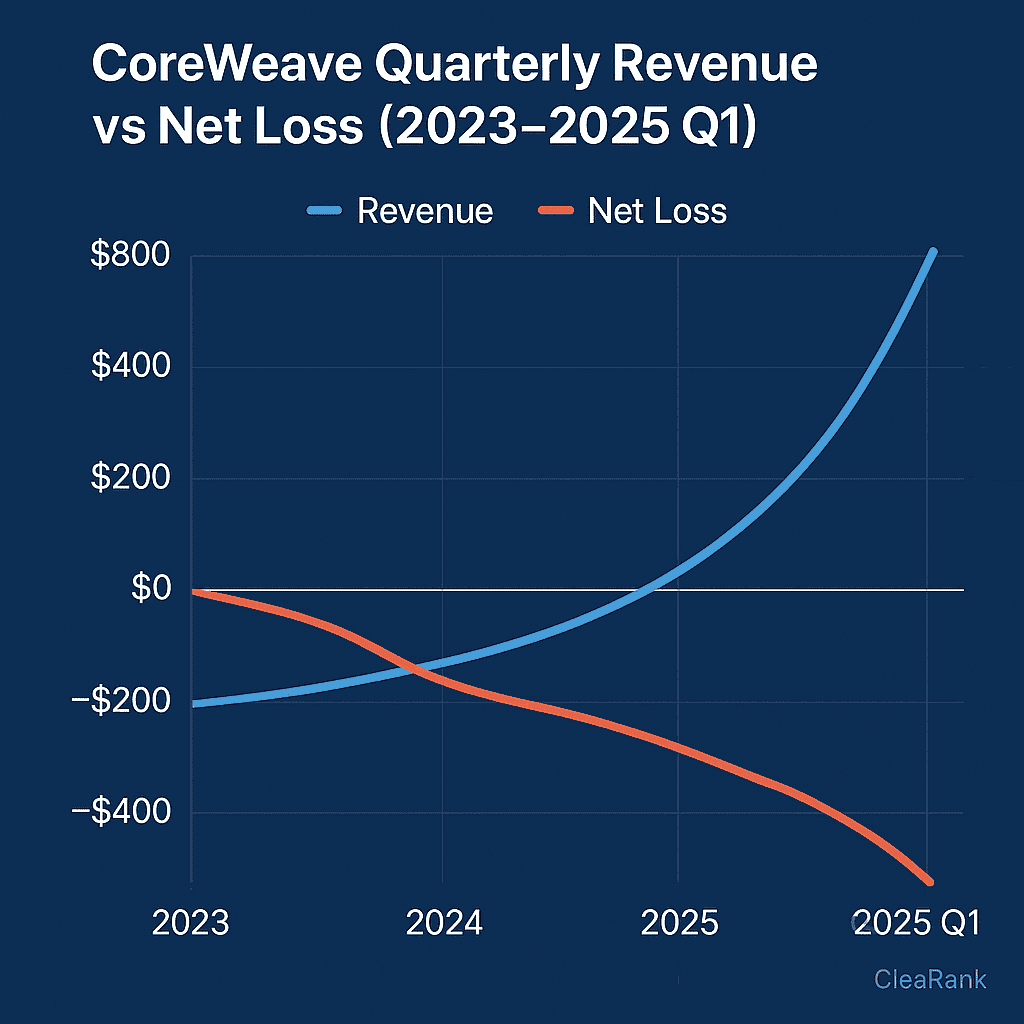
For Q1 2025, the group reported $982 million and a 420% increase in year-on-year revenue growth. This, combined with the announcement of $1.9 billion in capital expenditures towards future investments, means the company is well-positioned for growth.
“We’ve delivered an outstanding start to 2025 on multiple fronts. Our strong first quarter financial performance caps a string of milestones, including our IPO, our major strategic deal with OpenAI, as well as other customer wins, our acquisition of Weights & Biases and many technical achievements,” said Michael Intrator. “Demand for our platform is robust and accelerating as AI leaders seek the highly performant AI cloud infrastructure required for the most advanced applications. We are scaling as fast as possible to capture that demand. The future runs on CoreWeave.”
Michael Intrator, CoreWeave’s Co-Founder and Chief Executive Officer
Why CoreWeave’s AI Infrastructure Matters
“This isn’t just another tech cycle, it’s an infrastructure arms race,” says Shaun David. “Every major company building AI models needs raw GPU power, fast bandwidth, and cloud partners who can deliver it at scale. That’s where CoreWeave fits in. It’s not hype; it’s structural demand for real compute. And the companies that own the pipelines will own the future of AI.”
Shaun David, Co-Founder of CleaRank
Not Just Another Cloud Company: The Nvidia-CoreWeave Flywheel
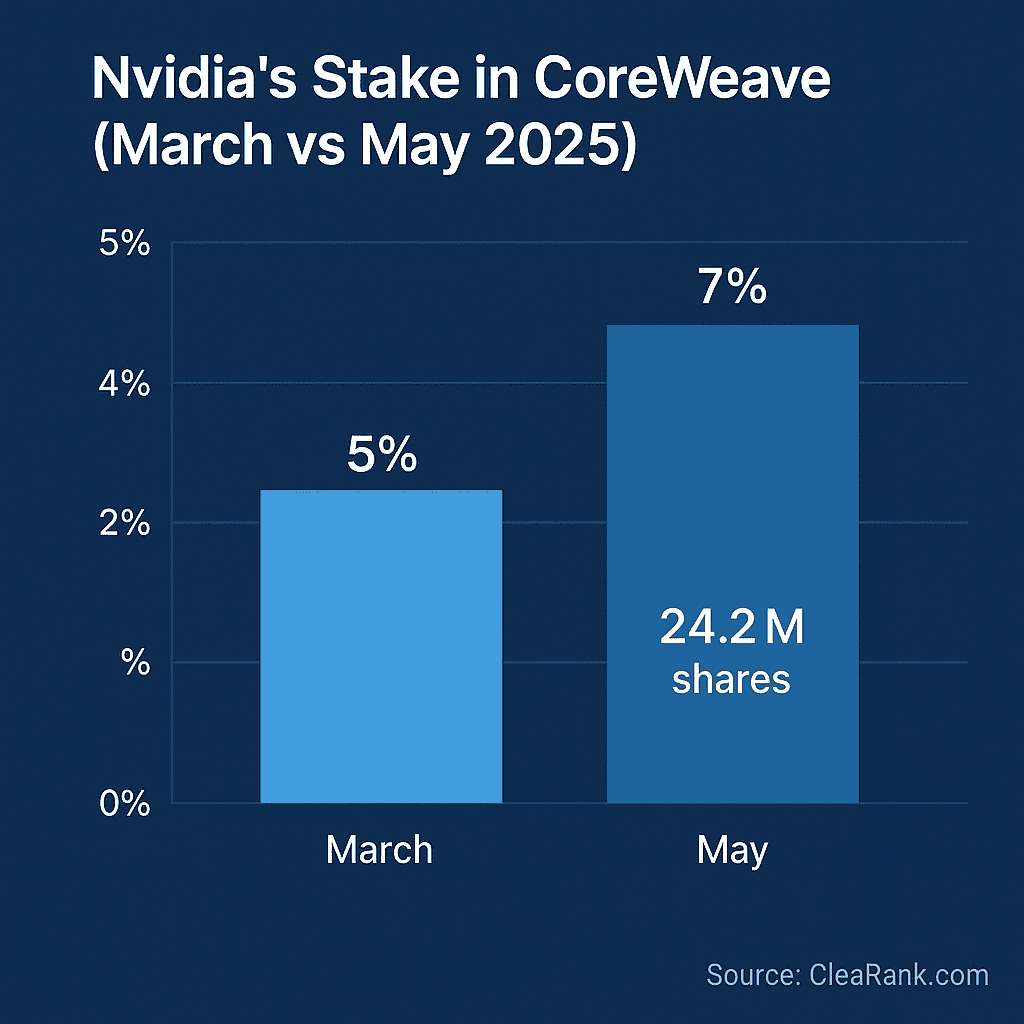
While the results would be positive for most tech companies, they don’t tell the full story. Notably, one of the major investors in CoreWeave is global investment darling Nvidia, which owns approximately 24.2 million shares in the company (around 7%).
Notably, when CoreWeave went public in March 2025, Nvidia held just 5% of shares, indicating that the chipmaker sees value in increasing its investment and future growth at CoreWeave.
This makes sense as selling products based on Nvidia GPUs is a core component of CoreWeave’s business model. But it also serves as a self-fulfilling prophecy of sorts as institutional and retail investors who are long on Nvidia become increasingly bullish on CoreWeave.
It’s also not the only major AI investor with a stake in the company. ChatGPT-maker OpenAI has signed a strategic deal with the group, adding $11.2 billion in revenue backlog. This follows an initial investment of $350 million in March, which saw the group take a stake in CoreWeave.
In its results presentation, CoreWeave also announced a partnership with IBM to deliver compute capacity for IBM’s Granite models. These investments effectively set up CoreWeave as a major player in the future of AI. These investments have created a relationship where CoreWeave’s success directly benefits Nvidia’s ecosystem and vice versa, potentially creating a flywheel effect for both companies.
At the same time, OpenAI’s investments provide stability and prestige.
This dual validation from both the hardware and software giants of AI suggests CoreWeave isn’t merely riding the AI wave but rather becoming a key player. For investors seeking exposure to AI’s growth trajectory beyond the usual suspects, CoreWeave represents a potential opportunity to invest directly in the specialized cloud infrastructure that will determine AI’s growth going forward.
“The AI gold rush is in full swing, but CoreWeave is one of the few selling the picks and shovels,” Shaun David explains. “While everyone’s chasing the next ChatGPT, CoreWeave quietly supplies the muscle. GPU cloud infrastructure is a bottleneck in the AI supply chain, and whoever controls that bottleneck controls the pace of innovation.”
Shaun David, Co-Founder of CleaRank
Risks to CoreWeave’s Growth: Capex, Geopolitics & Bubble Fear
While CoreWeave’s growth has been impressive, there are some potential red flags that investors should take note of. The group’s net loss increased from $129 million in Q1 2024 to $315 million. At the same time, it set a capital expenditure forecast of $21.5 billion for 2025, more than four times its expected revenue for the year.
Like other AI companies, CoreWeave is also especially sensitive to Donald Trump’s proposed tariff plan as it relies heavily on imported components. It also faces geopolitical risks from China as it and Nvidia rely heavily on semiconductors produced in Taiwan.
Finally, there are growing questions about whether we are now in an AI bubble, especially as tech giants see their share prices climb to record highs. As capital expenditure grows, investors will want to see tangible products with real-world use cases and not just expensive chatbots, which are prone to hallucination. As an infrastructure provider, CoreWeave should be less exposed to these risks, but if the AI bubble blows up, it will likely go down with the other major players.
“It’s not 1999 all over again, but we’re definitely pricing in perfection,” warns Shaun David. “CoreWeave’s positioning is strong, but investors need to remember: infrastructure firms are capital-intensive. If AI demand even slightly underdelivers, these high-multiple plays can correct fast. The key is watching execution, not just headlines.”
Shaun David, Co-Founder of CleaRank
CoreWeave vs. Other AI Infrastructure Plays
While CoreWeave has captured headlines, it’s not alone in the AI infrastructure race. Competitors like Lambda Labs, Cerebras, and even Amazon’s Trainium-backed AWS are making moves. Yet few have secured as much early-stage confidence from Nvidia, OpenAI, and IBM combined. The question is whether CoreWeave can maintain its first-mover advantage, or if the capital burden becomes too heavy as the AI hype matures.
FAQ
What does CoreWeave do?
Originally operating in the Ethereum mining space, CoreWeave pivoted from cryptocurrency to AI infrastructure in the early 2020s. CoreWeave now specializes in providing cloud-based GPU infrastructure to AI developers and companies. It also develops chip management software. Its business model essentially sees it renting out its more than 250,000 GPUs to help train Large Learning Models (LLMs) and other AI software. You can read more about CoreWeave here.
How are CoreWeave and Nvidia connected?
Nvidia was an initial investor in CoreWeave when it went public and held a 5% share in the company. It has since increased this share to 7%. Since CoreWeave relies heavily on Nvidia GPUs, investors see the two companies as increasingly intertwined.
What is CoreWeave’s partnership with OpenAI and IBM?
CoreWeave has signed agreements with both OpenAI and IBM, cementing its status as an AI software and hardware provider. While the specifics of the OpenAI are not known, the deal has added $11.2 billion in revenue backlog. The deal with IBM will see it deliver compute capacity for IBM’s Granite models.
What are the concerns around CoreWeave’s business model?
CoreWeave is clearly still in a growth phase and its projected $21.5B in 2025 capital expenditures outweighs its current revenue by more than 4x. There are also concerns about how tariffs might impact the broader AI market and whether we are currently facing an AI bubble. You can read more about the potential risks of CoreWeave here.
Ryan Brothwell
Ryan Brothwell is a seasoned Editor and Journalist with over a decade of experience in the fintech, blockchain, and media industries. Working across Africa and Europe, he has broken stories on everything from new laws to corporate corruption. A self-professed nerd, he enjoys consuming as many books, games and films as he can in his free time.