
Reviewed by Michelle Sofia Michelle Sofia
Market Analyst
As a financial journalist and a SEO specialist my passion for making education in finance accessible runs deep. My work combines hands-on market trend analysis with straightforward writing to create content that’s both informative and easy to understand for the average reader. At CleaRank, we’ve built our reputation on a simple idea: transparent broker comparisons shouldn’t be reserved for experts because everyone deserves clear and transparent information, especially when it comes to choosing a broker. Day to day, I focus on refining our educational materials to maximize their visibility and usefulness across trading communities. using our CLEAR™ Methodology The CLEAR™ Score (Credibility, Leverage, Execution, Accessibility, Regulation) is our proprietary ranking system. The CLEAR™ Score provides you with the most accurate and transparent broker ranking after evaluating all the key factors that are crucial for trading success. .
Last fact check on November 12, 2025 by
Jacob Bakshi Jacob Bakshi
Senior Market Strategist
Trading CFDs and options has been my playground for years, and I love helping others understand these powerful tools and what makes the financial world tick. My work mostly focuses on giving traders the confidence to make informed decisions with unbiased reviews into platforms that prioritize fair pricing, advanced tools, and reliable execution because In fast-moving markets, every detail matters. I have a background in market analysis and risk management, and I’m always on the lookout for brokers that offer the right tools for serious traders.
Trade The Pool Review 2026
Trade The Pool is a stock-focused proprietary trading firm headquartered in Israel with a satellite office in London. Their key selling point is giving traders access to significant buying power without the dreaded PDT rule. Their programs promise up to a whopping $200,000 in buying power with no restrictions or overnight holds, and 70% profit split. Our intense 3-month testing phase was mostly positive but it did yield some mixed results. The absence of daily drawdowns and pre-market trading flexibility stood out but we had some recurring concerns such as steep one-time evaluation fees and inconsistent customer support. Using our CLEAR™ scoring system we dissected every aspect of TTP’s offerings and it yielded many conclusive results.
CLEAR™ Certified Prop Firm

CLEAR™ CERTIFIED PROP FIRM: 4.3/5
- No PDT Rule
- Swing Trader Freedom
- Transparent Scaling
- Multi-Account Management
- Free 14-Day Trial
Reputation4.5
Account Types and Fees4.3
Trading Conditions4.4
Platforms4.1
Payout Process4.2
Customer Support4.0
Reputation4.5
Account Types and Fees4.3
Trading Conditions4.4
Platforms4.1
Payout Process4.2
Customer Support4.0
Why Choose Trade The Pool
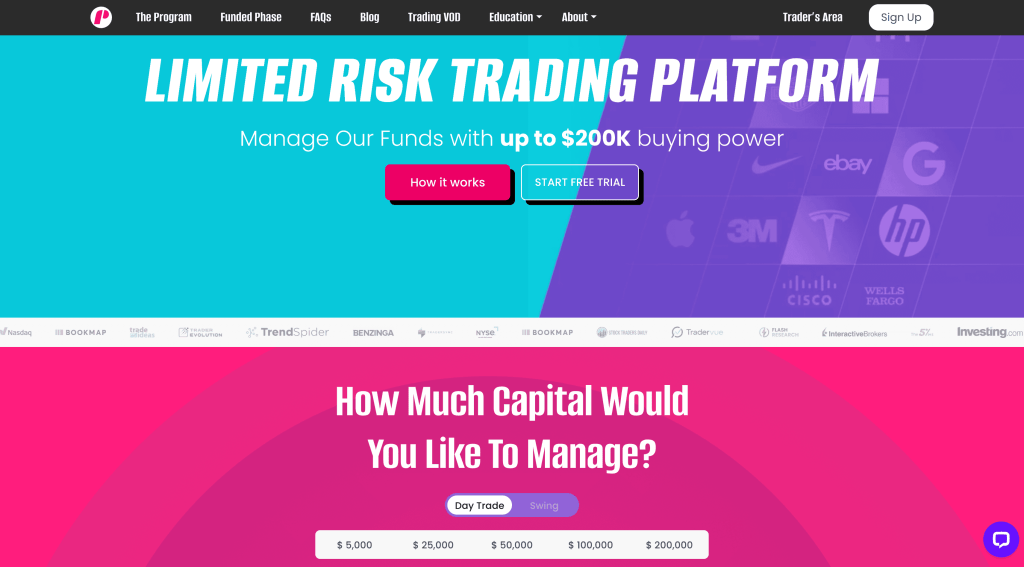
Trade The Pool’s biggest draw is its unrestricted access to U.S. equities, including penny stocks and ETFs. Now if you factor in their no PDT rule, it’s a lifeline for day traders running short on capital. We kicked off the test phase by jumping right into their volatile small-caps like NVDA and TSLA during pre-market hours and were greeted by an impressive range of over 12,000 tradable instruments. We also found the scalability options of growing from $5K right up to $200K buying power to be fairly compelling for their MAX and FLEX plans. However, the 60-day MAX evaluation window adds pressure and we felt the heat right from the start, so we suggest you first dip your toes into their 14-Day free trial. In terms of the profit splits, they offer 70% on most accounts, which is not industry leading but it’s reasonable. Swing traders can hold positions over weekends without daily loss limits which is a rare perk in the prop space.
Pros
Accounts under $25K drift under the radar of SEC restrictions, so you can day trade freely.No PDT Rule
Swing traders can hold trades over the weekend and aren’t forced to liquidate daily.Overnight and Weekend Holds
There is an impressive range of over 12,000 tradable instruments that include stocks, ETFs, and volatile penny stocks.Diverse Instruments
You can test strategies and become acquainted with the platform before committing funds. This is not commonplace in the prop trading industry but it's essential.Free 14-Day Trial
Your buying power gets a major boost by hitting profit targets, this is precisely how it should be.Transparent Scaling
Cons
Their evaluations fees start at $97 and go up to an eye-watering ,240. These costs are paid upfront and are non-refundable if you fail.
Forget about hitting home runs here, your most profitable single trade can’t exceed 50% (30% for MAX during evaluation) of total profits. That lowers your chances of getting funded by a fair margin.Consistency Rules
It's a one trick pony as they only support TraderEvolution. We always prefer to have a diversified toolset in our trading armory.Platform Limitations
You need to actively monitor your account as it auto-liquidates 10 minutes before market close if not and that increases the risks of an unplanned exit.Inactivity Closures
Their support responses during U.S. trading hours were delayed. They are based in Israel, so the timezone difference could be the reason. Either way this needs improvement. Delayed US Support
Accounts under $25K drift under the radar of SEC restrictions, so you can day trade freely.No PDT Rule
Swing traders can hold trades over the weekend and aren’t forced to liquidate daily.Overnight and Weekend Holds
There is an impressive range of over 12,000 tradable instruments that include stocks, ETFs, and volatile penny stocks.Diverse Instruments
You can test strategies and become acquainted with the platform before committing funds. This is not commonplace in the prop trading industry but it's essential.Free 14-Day Trial
Your buying power gets a major boost by hitting profit targets, this is precisely how it should be.Transparent Scaling
Their evaluations fees start at $97 and go up to an eye-watering ,240. These costs are paid upfront and are non-refundable if you fail.
Forget about hitting home runs here, your most profitable single trade can’t exceed 50% (30% for MAX during evaluation) of total profits. That lowers your chances of getting funded by a fair margin.Consistency Rules
It's a one trick pony as they only support TraderEvolution. We always prefer to have a diversified toolset in our trading armory.Platform Limitations
You need to actively monitor your account as it auto-liquidates 10 minutes before market close if not and that increases the risks of an unplanned exit.Inactivity Closures
Their support responses during U.S. trading hours were delayed. They are based in Israel, so the timezone difference could be the reason. Either way this needs improvement. Delayed US Support
Reputation: Credible Stock Prop Firm
CLEAR™ Score 4.5/5
Trade the Pool is owned by the same guys who created The5ers, an industry leading forex prop firm with a strong track record so that lends some credibility. But there is no stronger indicator than real world hands-on experience, so we used our Verified Feedback™ AI tool to comb through over 850 trader reviews and we found plenty of positives. TTP is praised for its equity focus, PDT flexibility, and the ability to short any stock instantly. The only major complaints we came across were the high post-failure recovery fees, which always feel like a dagger to the heart, and the tough trade rules which mean you have to bring your best game.
What Traders Loved
- Pre/after-market trading access.
- The ability to short stocks without locate fees. The firm takes care of the locate fees, which is one of their main benefits.
- Large buying power which is great value for money
- Quick confirmed payouts, 1-2 business days.
- New MAX and FLEX day trading plans offer cheaper entry points and flexible timelines.
What Traders Hated
- Daily liquidation at 3:50 PM ET.
- Tough trade rules
- Wider spreads due to less liquidity.
- Platform limitations and stability issues.
Website Audit: Trade The Pool
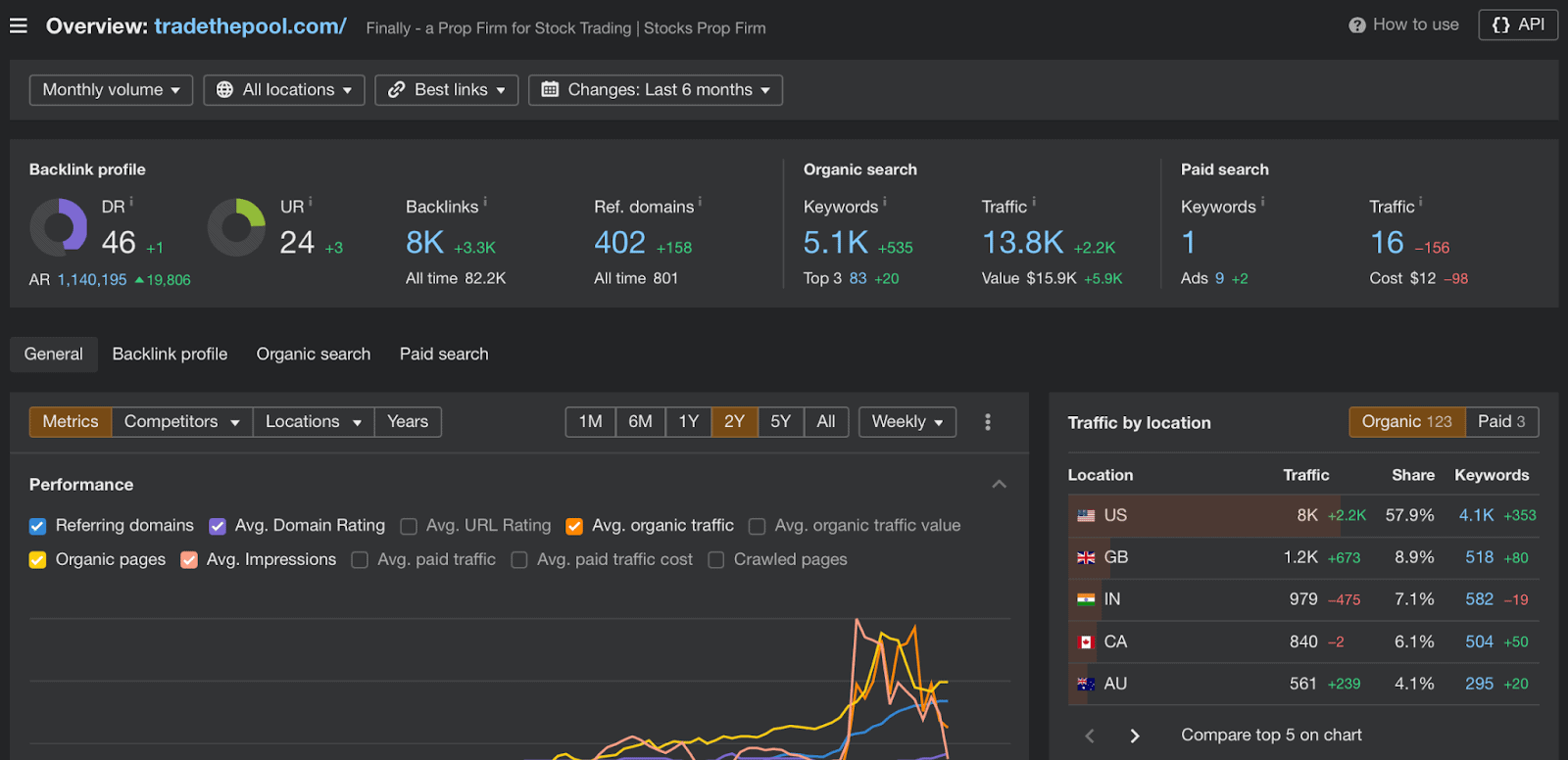
We ran a complete website audit of Trade The Pool using Ahrefs. The results painted a credible picture, solidifying what we had already concluded. They have large scale organic traffic with consistent growth, particularly in the US and the UK, which shows that they’re gaining traction and popularity. Consistent growth like this can only really be achieved by harvesting solid brand reputation and performance. The audit also indicated that they run small scale Google Paid Search advertising. Only reputable brokers and prop firms are allowed to promote their services on Google per their compliance guidelines.
Interview with the Trade the Pool Leadership
Q&A Session with Gil Ben-Hur, Trade The Pool Founder
What inspired you to start Trade The Pool and what gives TTP the winning edge over other prop firms?
Gil: I started Trade The Pool because I saw a gap in the trading world. Too many are held back by lack of capital or outdated rules. We break down those walls by giving you buying power, no PDT limits, and a risk-managed environment to trade freely. Our edge is that we don’t micromanage your strategy. Instead, we invest in your growth through education and community. Simple, transparent, trader-first.
Please explain your new FLEX/MAX day trading evaluation programs and the rationale behind these changes?
Gil: FLEX and MAX are our direct responses to trader feedback and market shifts. FLEX removes deadlines for low-pressure grinding and MAX trims fees for fast-trackers. We tightened risk controls but without compromising flexibility. We also rebuilt buying power scaling, and smoothed evaluations so traders can advance quicker.
You only offer the TraderEvolution platform, are there any plans to add new platforms and tools?
Gil: TraderEvolution’s our home base and it’s a solid one. However, we’re always working on hooking up more tools. Think along the lines of plugins for your favorite charting apps or algo scripts but minus the platform hopping.
What initiatives are in place to support and educate traders so that they match the TTP’s trading philosophy?
Gil: We’ve launched over 100 pro-taught videos (strategies, risk hacks, mindset drills), live coaching, and a tight-knit trader community.
How does TTP deal with risk management? We’re specifically referring to the no-PDT rule and the major buying power offered to traders.
Gil: Risk? We take it very seriously. You won’t find PDT handcuffs here as we give you capital but track every move in real-time. Our tech and risk team track all the trades very closely. If we spot a risky move? You’ll know about it, that’s for sure. Now in terms of big buying power? It scales as you prove consistency. We want to give you the best chance of growing big without blowing the account.
Trade The Pool is showing strong and consistent growth in the U.S. market. Do you have any expansion plans for emerging markets such as Brazil, Latin America, and Asia?
Gil: We’ve done really well in the U.S. but it’s just the beginning. Emerging markets like Brazil, LATAM, and Asia are definitely up next. Traders there struggle for capital and face shaky infrastructure so we’re teaming up with local experts to adapt our model. Global prop trading should be available anywhere in the world. So that’s our mission, we’re breaking down barriers and making trading accessible to everyone.
Q&A Session with Michael Kats, Trade The Pool CEO
How is Trade The Pool integrating AI and machine learning to improve trading signals, strategies, and platform functionalities?
Michael: We use AI and machine learning to improve trader evaluations, optimize risk management, and continuously upgrade trading tools. Our system analyzes trader performance in real time, allowing us to identify their strengths, weaknesses, and optimal scaling opportunities. On top of that, we’re also exploring AI-driven insights to help our traders recognize patterns and improve their decision-making.
What’s the best advice you could give to new traders who strive to get funded by Trade The Pool?
Michael: The best traders are disciplined, patient, and consistent. They don’t chase big wins but rather follow a calculated strategy. The biggest mistake we see from new traders is over-trading or taking excessive risks just to reach the funding target Faster. Trade slow, hone down a strategy, manage risk, and let profits stack organically.
What has driven the fast growth of Trade The Pool, particularly in the U.S.?
Michael: Our U.S. growth boils down to five pillars: Risk-capped freedom (trade with $200K buying power without personal ruin), PDT rule annihilation (day trade freely, short penny stocks, zero locate fees), trader-first tech (real-time tools, no lag, no bloatware), community over competition (learn from vetted pros, not YouTube gamblers), and zero ghosting (we’re in the trenches with live support, raw feedback, and relentless transparency).
What does a typical day of the Trade The Pool CEO look like?
Michael: My days are focused on tracking how our traders are doing, improving our platform, planning growth, and listening to feedback. I also spend a lot of time talking directly with our traders as their input affects everything.
Do you have any concerns and contingency plans regarding changes in U.S. regulations for prop trading firms? FTMO, for example, has ceased services to U.S. clients due to regulatory challenges.
Michael: Regulatory changes are always a factor in financial markets, and we closely monitor the evolving landscape, but Trade The Pool operates differently from many other prop firms. We trade real shares, not CFDs, and our traders trade our actual capital.
Account Types and Fees: More Love for Swing Traders
CLEAR™ Score 4.3/5
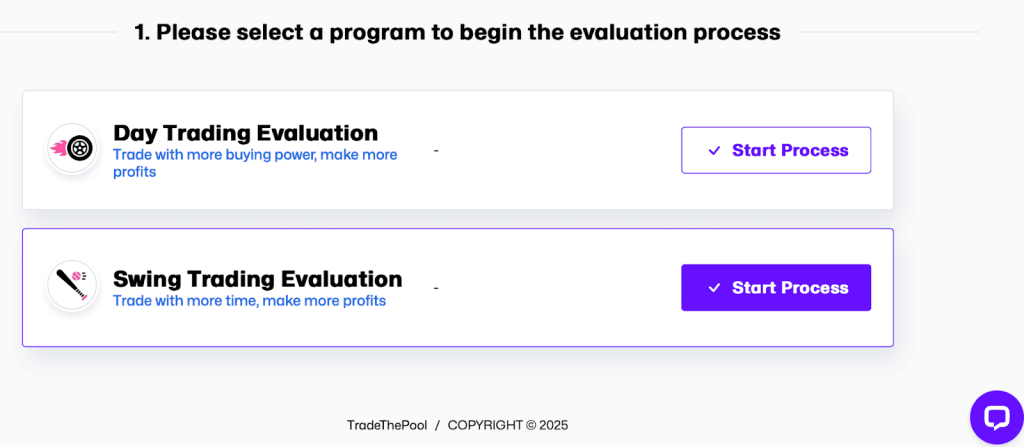
Trade The Pool splits its programs into Day Trader and Swing Trader evaluations, each with wildly different rules. We tested both for weeks and here’s our take:
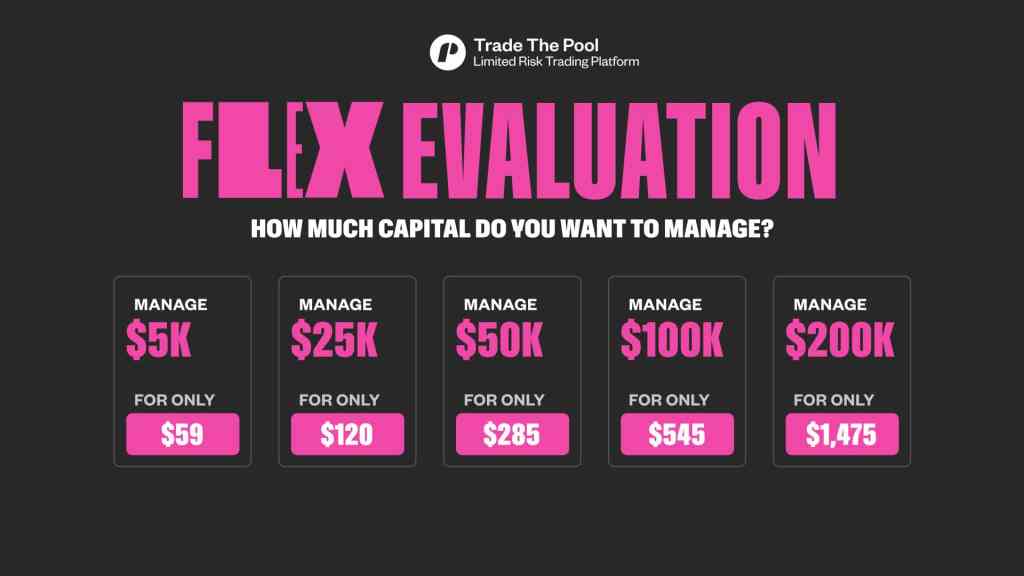
Day Trader Plans: FLEX vs. MAX Evaluations
Trade The Pool has overhauled its day trading programs, splitting them into FLEX and MAX Evaluations that cater to wildly different trader psychologies. We spent countless hours stress-testing both and the results were polarized. FLEX is more of a marathon with no time limits but tedious rules, while MAX is a sprint with 60-day deadlines and much cheaper fees. During testing, we pushed the $25K MAX account to its limits by scalping NVDA in 45-second bursts to hit the $1,500 profit target. It worked, well at least momentarily, until a rogue 2% daily drawdown clawed us back $500 overnight. Only one way to describe that, brutal!
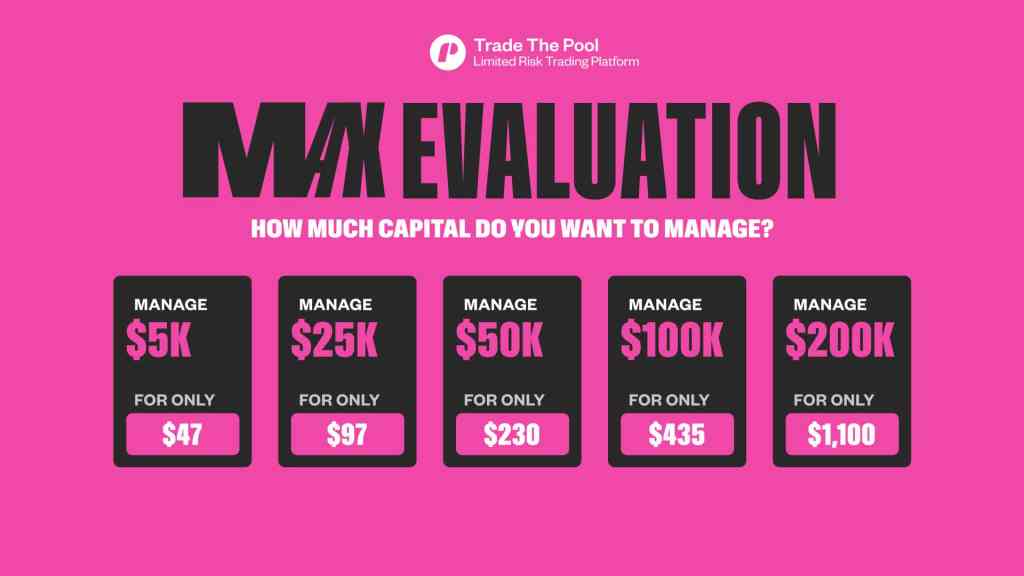
We approached the FLEX’s unlimited evaluation window free of deadline panic, but the 20-trade minimum per account did up the ante and was fairly demoralizing. Meanwhile, MAX’s 60-day countdown and lower upfront costs ($47 for $5K BP) are perfect for traders who thrive under pressure. Just don’t blink: its 2% daily pause rule (losses trigger a 24-hour account freeze) forces surgical precision.
Unlike futures prop firms like Apex Trader Funding, TTP’s model prioritizes stock and ETF traders seeking to bypass PDT rules and leverage buying power
Here’s how the tiers stack up:
FLEX Evaluation (Unlimited Time)
Buying Power | Fee | Profit Target | Max Loss | Daily Pause | Min Positions |
|---|---|---|---|---|---|
$5,000 | $59 | $300 (6%) | $150 | $50 (1%) | 20 |
$25,000 | $120 | $1,500 | $750 | $250 | 20 |
$50,000 | $285 | $3,000 | $1,500 | $500 | 20 |
$100,000 | $545 | $6,000 | $3,000 | $1,000 | 20 |
$200,000 | $1,475 | $12,000 | $6,000 | $2,000 | 20 |
MAX Evaluation (60-Day Grind)
Buying Power | Fee | Profit Target | Max Loss | Daily Pause | Min Positions |
|---|---|---|---|---|---|
$5,000 | $47 | $300 (6%) | $200 | $100 (2%) | 10 |
$25,000 | $97 | $1,500 | $1,000 | $500 | 10 |
$50,000 | $230 | $3,000 | $2,000 | $1,000 | 10 |
$100,000 | $435 | $6,000 | $4,000 | $2,000 | 10 |
$200,000 | $1,100 | $12,000 | $8,000 | $4,000 | 10 |
Key Day Trader Account Rules for both plans:
- Trade Duration: Minimum 30 seconds per trade are required, which means no quick scalps are possible.
- Consistency Rule: FLEX enforces a 50% cap (no single trade can be more than 50% of profits) even post-funding. MAX drops it to 30% during evaluation only and is removed post-funding.
- Inactivity: Accounts auto-liquidate after 14 days of no trades.
- Post-Funded Differences:
- FLEX Funded: Requires 3+ “profit days” (min 0.5% gains) before withdrawals.
- MAX Funded: No profit day quotas or consistency rules. You keep 70% of earnings.
Swing Trader Evaluations: Slow and Steady Wins
These “Beginner-Friendly” tiers ($3K–$39K) let you hold positions overnight and over weekends. That’s a genuine godsend if you’re targeting earnings plays. We held TSLA through a weekend during testing, bagging a 9% gain without daily drawdown headaches.
Swing Trader Evaluation (100 Days)
Program | Buying Power | Fee | Profit Split | Max Daily Drawdown | Max Total Drawdown | Notes |
|---|---|---|---|---|---|---|
Mini | $3,000 | $110 | 50% | $300 | $900 | Best for Beginners |
Super | $12,000 | $330 | 60% | $700 | $2,100 | Traders’ Pick |
Extra | $24,000 | $475 | 70% | $1,300 | $3,900 | Centered on Growing Traders |
Ultimate | $39,000 | $1,340 | 80% | $2,000 | $6,000 | Geared Towards Advanced Traders |
Demo Account | $1,000,000 | $0 | 0% | $10,000 | $50,000 | Testing Account |
Key Swing Trader Account Rules:
- No Forced Closures: Hold trades as long as you want—even over weekends.
- Lower Profit Targets: Example: $225 profit target for the 3K Mini BP.
What We Liked
- No Monthly Fees: Funded accounts have zero recurring costs, unlike Apex’s $85–$105/month fees.
- Upfront Clarity: You’re aware of your total cost upfront, there’s no nasty hidden charges post-funding.
- Scalability: You can grow from $5K to $200K by hitting clear profit targets.
- Swing Trader Freedom: You can hold positions overnight and on weekends and thus reduce liquidation panic during earnings plays.
- Demo Account: Always a good idea to practice first and you can do this without spending a dime on a $1M paper-trading account.
- Low Initial Fees: Just $47 minimum to get the ball rolling.
- Less Pressure for FLEX: Unlimited evaluation time for FLEX reduces the heat.
- Reduced Minimum Positions for MAX: The 10 position minimum is reasonable (FLEX is 20)
What We Didn’t Like
- No Refunds: Fees are non-refundable, even if you blow your account on day one.
- Increased Liquidation Risks on MAX: The 2% daily pause increases the liquidation risks.
- FLEX Requires 20+ Trades to Pass: We found this to be tedious.
Trading Conditions: Built for Strategic Holders, Not Thrill-Seekers
CLEAR™ Score 4.4/5
If you’re a scalper addicted to rapid-fire trades then Trade The Pool’s rules will feel like a straitjacket. TTP is Designed for patient swing traders and rewards calculated holds over reckless gambles. During testing, we held TSLA through a weekend earnings rollercoaster, netting a 9% gain without daily drawdowns breathing down our necks, proving that slow and steady wins the race. Day traders can’t get too cozy with the 60-day MAX evaluation period which slaps a ticking clock on your strategy, and the 5:1 risk-reward rule (max $500 risk per $100 profit target) forces meticulous planning. FLEX’s 50% consistency rule (no single trade >50% of total profits) persists even after funding, choking high-conviction plays.
FLEX vs. MAX Evaluations
FLEX Evaluation
Buying Power | Fee | Profit Target | Max Loss | Key Restriction |
|---|---|---|---|---|
$5,000 | $59 | $300 (6%) | $150 | 20-trade minimum, unlimited time |
$200,000 | $1,475 | $12,000 | $6,000 | 50% consistency rule post-funding |
MAX Evaluation
Buying Power | Fee | Profit Target | Max Loss | Key Restriction |
|---|---|---|---|---|
$5,000 | $47 | $300 (6%) | $200 | 60-day sprint, 2% daily pause |
$200,000 | $1,100 | $12,000 | $8,000 | 30% consistency rule (evaluation phase only) |
Swing Trader Evaluation
Account Tier | Buying Power | Fee | Profit Split | Profit Target | Max Loss | Key Restriction |
|---|---|---|---|---|---|---|
Mini BP | $3,000 | $110 | 50% | $225 | $900 | No forced liquidation |
Ultimate BP | $39,000 | $1,340 | 80% | $2,925 | $6,000 | Lower buying power cap |
What We Liked
- Overnight/Weekend Freedom: We held TSLA through earnings. There were no forced exits, just a real chance to profit.
- No Daily Drawdowns: Everyone has a bad day. Luckily you can rebound the next day without a rigid loss cap hanging over your head.
What We Didn’t Like
- 5:1 Risk-Reward Handcuffs: Scalpers can’t exploit quick moves and tight stops eat into profit margins.
- FLEX’s 50% Consistency Rule: This makes home-run trades impossible even after funding and a brutal setback for any conviction plays.
- No Penny Stocks: Tickers under $1.50 are blocked. You can say goodbye to speculative meme-stock chaos.
- Mandatory Stop-Losses: Hard stops are required on every trade which basically kills flexibility for reversal strategies.
- 60-Day MAX Crunch: Pass or get reset, there are no extensions even if you’re $100 short of the target
Platforms: Solid B-Tier Platform
CLEAR™ Score 4.1/5
We’ve become accustomed to brokers and prop firms offering multiple platform options that deliver a complete trading toolkit. Trade The Pool instantly lost points in that department as they only offer TraderEvolution, a versatile stock platform that is behind the competition. During our 3-month testing grind, we executed over 400 trades across devices, from pre-market caffeine rushes to blurry eyed after-hours sessions. The platform seamlessly delivered real-time NASDAQ/NYSE data and we enjoyed the clean interface, but the experience was a far cry from NinjaTrader-level customization.
Overall we found it to be a solid B-tier platform, reliable for swing traders and casual day traders. However, this is not the platform for algo enthusiasts and experienced technical analysts as it lacks support for API access or Python scripting. If you’re okay with trading vanilla strategies and value cross-device access, it’s a win. Just don’t expect it to replace your Bloomberg Terminal fantasies.
TraderEvolution Key Features
Feature | Performance | Best For |
|---|---|---|
Execution Speed | 45ms avg. order execution | Swing trading, moderate-frequency |
Slippage (Volatile Markets) | 0.5 ticks on average | Steady equities. It would not be ideal for penny stocks. |
Stability During News | 1 brief freeze during Fed announcement | Non-HFT strategies |
Accessibility | Browser, mobile, desktop | Trading on the go |
Customization | Basic charting tools, no Python/API scripting | Discretionary traders |
CLEAR™ Execution Tracker Insights
We hammered TraderEvolution with simulated trades during earnings chaos and Fed events. Here’s how it held up:
Metric | Result | Our Findings |
|---|---|---|
Avg. Order Execution | 45ms | Decent for retail traders, but lagged behind Rithmic’s 27ms with other prop firms. |
Slippage | 0.5 ticks (calm) / 2.1 ticks (volatile) | We experienced 0.5 ticks in calm markets but it ballooned to 2.1 ticks during earnings reports and big news events. |
Stability | 10-second freeze | Encountered during the Fed Chair speech; annoying but recoverable. |
What We Liked
- Real-Time Data with No Extra Cost: NASDAQ/NYSE feeds are included. There’s no sneaky $50/month fees which has unfortunately become commonplace.
- Clean Interface: Drag-and-drop charts beat MetaTrader’s clunky UX. But that’s about the only real advantage over industry leading platforms.
- Platform is Browser Based: Saved us the headache of having to install yet another platform.
What We Didn’t Like
- Algo Limitations: No API or Python scripting, which means it’s a no-go for quant strategists.
- Charting Stone Age: We found only basic indicators such as RSI, MACD. Forget custom Ichimoku clouds.
- Mobile Lacks Conditional Orders: No conditional orders on the app forced us to babysit trades.
Payout Process: Bi-Weekly Flexibility with a Catch
CLEAR™ Score 4.2/5
We see the payout phase as one of the most important features for traders, so when it comes to scoring we heavily penalize anything that is not 100% streamlined. At first glance, Trade The Pool offers the standard bi-weekly payouts via PayPal, Wise, or wire transfers. However, when we processed a payout outside of the U.S. it took almost 7-days for the funds to arrive in our account. We assume that this is due currency conversions and Wise’s processing lag, nevertheless it’s not good enough. When we processed a payout from the U.S., it was a different story with funds reaching our account within 3 business days. During testing, we hit another snag which was frustrating. The mandatory 14-day withdrawal waiting period for both plans locked profits for two weeks post-target. This throttles liquidity for any traders needing quick access to earnings.
Overall, the payout process is reasonably efficient, but international delays and the 14-day hold drag down the CLEAR™ score.
What We Liked
- Bi-Weekly Flexibility: You can request payouts every 14 days, there’s no preset rigid windows.
- Multiple Payment Options: You have a decent choice of PayPal for speed, Wise for low fees (1% FX rate), wires for large sums.
- Auto-Generated Tax Docs: 1099 (U.S.) and W-8BEN (non-U.S.) forms simplify tax headaches.
What We Didn’t Like
- 14-Day Withdrawal Hold: Profits are locked for two weeks post-target which delays access to hard-earned gains.
- No ACH for International: U.S. traders get ACH (2–3 days), others pay wire fees.
- $300 Minimum Withdrawal: Forces small-balance traders to wait weeks for payouts.
- No Crypto Options: Wire transfers/PayPal only and it comes with fees.
Account Opening: Swift Setup with Hidden Hurdles
CLEAR™ Score 4.3/5
We found Trade The Pool’s account setup to be fast and with no major bumps in the road. During the testing phase we opened and activated a $5K Day Trader account in 8 minutes flat. That’s impressive efficiency made possible by the fact that no upfront KYC is required for evaluations and we were ready to start trading right away. But don’t be smitten by the speed, there are hidden costs and post-funding requirements lurking beneath the surface, that may catch many traders unaware.
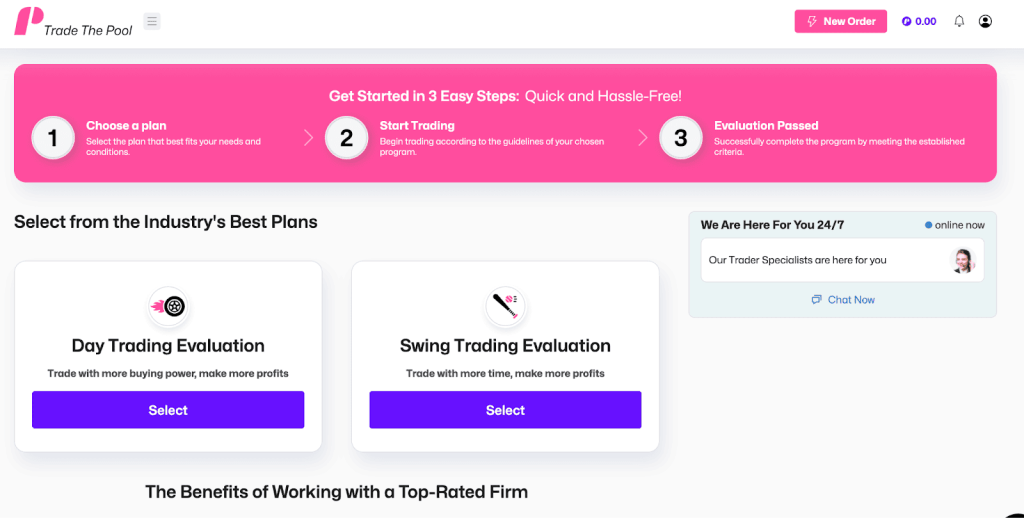
Step-by-Step Guide to Opening a Trade The Pool Account
Step 1: Choose Your Program and Pay
- Select Program: Pick a Day Trader Account FLEX/MAX ($5K–$200K) or Swing Trader Account ($3K–$39K) per your preference. Expect to pay between $47 (MAX PLAN) right up to a whopping $1,340 (Ultimate BP – Swing).
- Enter Details: Provide email and password or just sign in with your Google account. There’s no ID verification needed for evaluations.
- Apply Discounts: Use promo codes to save a few bucks (check the TTP website for any available codes).
- Pay Fee: Credit or debit only are accepted. Unfortunately no crypto option. Fees are non-refundable.
Step 2: Platform Setup
- Instant Access: Trader Evolution login details arrive via email within 15 minutes.
- Connect Tools: Browser, mobile, or desktop—no downloads required.
Step 3: Evaluation Phase
- Trade Simulated Account: Hit profit targets.
- Key Rules:
- 60-Day or 100-Day Deadline depending if you choose a Day or Swing Trader Account: You either meet the evaluation criteria before deadline or you’ll be reset.
- FLEX 50% Consistency Rule: No single trade can drive more than 50% of profits. For MAX evaluation plan its a 30% consistency rule
- Mandatory Stop-Losses: Hard stops on all positions.
- Reset Options: You pay $50–$200 (based on the account size) to retry.
Step 4: Funded Account Activation
- Pass Evaluation: Account resets to starting balance with live trading rules.
- Withdraw Profits: Bi-weekly payouts via PayPal/Wire ($500 minimum).
What We Liked
- No Upfront KYC: Start trading in minutes—no ID checks during evaluations.
- Free Trader Evolution Access: No extra fees for real-time NASDAQ/NYSE data.
- Unlimited Retries: Reset evaluations endlessly (for a fee).
- Multi-Account Management: You can trade up to 5 accounts at the same time, which may improve your chances of passing the evaluation phase.
What We Didn’t Like
- Non-Refundable Fees: You lose anywhere from $97–$1,340 if you fail evaluations. The costs add up fast as you need multiple attempts.
- Post-Funding KYC: Full ID verification is required for payouts. This may come as a surprise to some and it delays international withdrawals.
- Static Rules: Mandatory stop-losses limit reversal strategies.
- No Crypto Deposits: Credit, debit, or wire transfers only. Many view crypto as the most efficient form of account funding.
Customer Support: Quick Fixes, Time Zone Delays
CLEAR™ Score 4.0/5
Quick round the clock support is crucial for trading success as any significant technical issue can undo weeks of hard work and cause you to fail the evaluation phase. Trade The Pool does its best to provide just that, but our tests revealed otherwise. They are headquartered in Israel so their support team is mostly available during Israeli business hours which are Sunday–Thursday from 7:00–17:00 GMT. Our minor queries and basic issues like password resets were resolved within minutes. But if you’re in New York or Mumbai? You’re out of luck as queries sent outside Tel Aviv’s workday are slow to receive a response. We tested all their support options such as live chat, Discord community, and email, which revealed stark geographic gaps in service quality.
Customer Support Performance Results
Support Channel | Our Findings |
|---|---|
Live Chat | They responded within 5-minutes for basic queries (e.g., password resets) during Israeli hours. However, we faced over 12-hour delays during U.S. evenings and Asia mornings. |
Phone Support | Not offered. They rely on email and chat only. |
Email/Help Desk | Israeli and EU based clients can expect a 24-hour resolution for urgent requests. That stretches to between 48–72 hours for U.S. or Asian based traders. |
Social Media | Twitter/X (@TradeThePool) replies in 6–12 hours. The Discord mods are active daily mostly during Israeli office hours. |
What We Liked
- Live Chat Speed: They fixed our login error during a Tel Aviv morning in 2 minutes flat.
- Proactive Discord Alerts: We found that Mods pinged users during a platform outage caused by Fed news.
- Help Center Depth: Found answers to 80% of our questions (e.g., profit splits) via guides and videos.
- Clear Escalation Paths: Our urgent tickets flagged as “critical” got prioritized.
What We Didn’t Like
- U.S. Afternoon Blackout: Live chat offline by 9:00 AM PT, which leaves traders stranded during peak U.S. market hours.
- Weekend Abandonment: No proper support Fridays or Saturdays. That’s brutal if you’re a swing trader that’s holding.
- Google Translate Replies: Spanish/French tickets got garbled, AI-translated responses.
- No Phone Lifeline: Email-only escalations for payout disputes dragged resolutions to over 7 days.
Trade The Pool FAQ
What is Trade The Pool?
Trade The Pool (TTP) is a stock trading prop firm that specializes in U.S. equities and ETFs. It has grown immensely popular due to the massive buying power (up to $200K) and its no PDT rule.
Is Trade The Pool Legit?
Yes, Trade The Pool is a legitimate prop firm operated by Five Percent Online Ltd (parent company of The5ers). It received a CLEAR™ certified score of 4.3/5 after passing multiple stress and safety tests by CleaRank.
Where is Trade The Pool Located?
TTP is headquartered in Raanana, Israel, with a satellite office in London, UK.
Who Owns Trade The Pool?
Founded in 2025 by Gil Ben Hur (also founder of The5ers), a forex trader turned entrepreneur, TTP was created to address gaps in equity-focused prop trading.
How Does Trade The Pool Work?
You need to first pass the Evaluation Phase per their strict criteria. You’ll then reach the Funded Phase where you get to Keep 70–80% of profits (based on account size) with no monthly fees.
How Does Trade The Pool Make Money?
They make money from the evaluation and reset fees. That’s not all! They also keep 20–30% of your earnings post-funding per their profit split.
How to Set Up Trader Evolution for TTP?
After purchasing an evaluation, you’ll receive Trader Evolution login credentials via email. You can then connect via browser or mobile app.
Michelle Sofia
CleaRank started with the simple yet powerful vision that transparent and unbiased broker information should be available to everyone, not just those within the industry. This is where I come in with my many years of experience in financial journalism and SEO. Every day, I focus on creating and refining educational content that truly speaks to trading communities and making it both easy to find and genuinely helpful. It’s all about giving people the knowledge they desperately need in order to make informed decisions—step by step, one article at time.